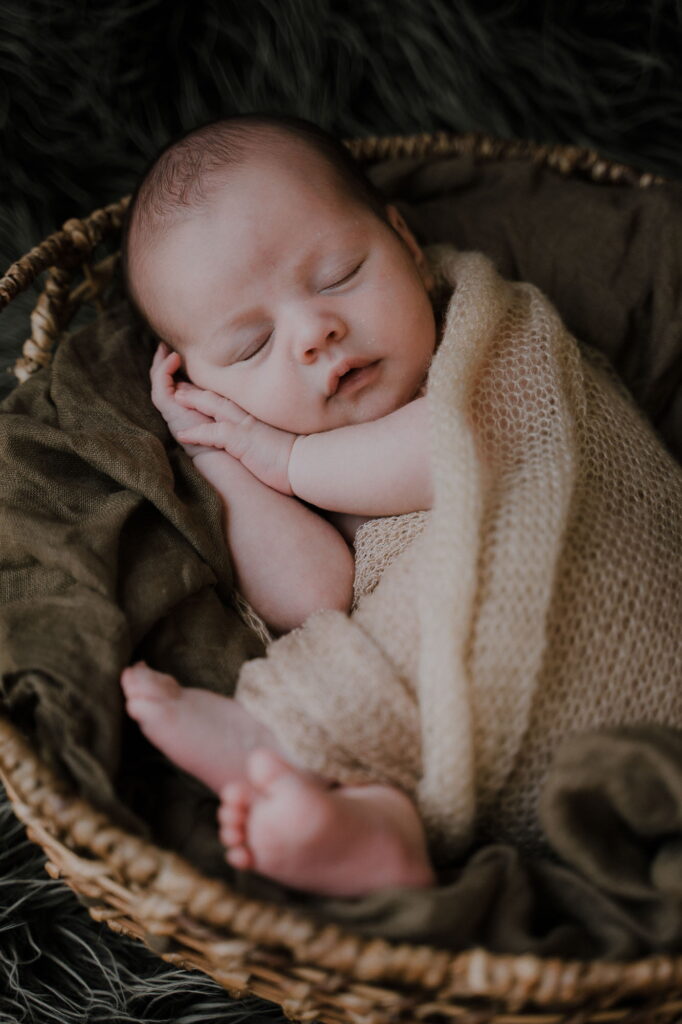
Short answer: The full moon (滿月) marks a baby’s first month, and in many Chinese families it is celebrated with a gathering and gifts of red-dyed eggs. Photographically it sits just after the newborn posing window closes, so a one-month-old photographs awake and stretched out rather than curled and asleep.
Lin, my wife, is Chinese, and between her family and the clients we photograph around Epping and Eastwood we have been in a good number of full-moon rooms. The custom is well known. What is less well known is what it means for the pictures, because a one-month-old is a genuinely different photographic subject from a one-week-old, and most studios quietly book them as if they were the same thing.
What the full moon marks
滿月 means the month completed. It is the first real milestone after a birth, and the gathering that goes with it — 滿月酒 in many families — is often the moment the baby is properly introduced to relatives and friends who have been waiting a month to meet them.
Red eggs are the emblem most people recognise. Eggs dyed red, given out to guests or delivered to family, are a Cantonese tradition in particular, frequently paired with pickled ginger. Red for good fortune, eggs for new life. Some families send a box around the neighbourhood; some pile them on a table at a restaurant lunch.
Other practices vary by region and family. In some, the baby’s hair is shaved for the first time around this point. In some, this is when the child’s name is formally used with the wider family. We do not assume any of it. When a family books, we ask what theirs does, and we build the session around that rather than around a checklist.
The overlap nobody explains, and it matters
This is the practical point of this whole article.
Studio newborn photography — the curled, sleeping, folded-up images most people picture — works because of a physical window. For about the first two weeks a baby still settles into the shapes they held before birth, and they sleep deeply enough to be moved gently between them. From roughly three weeks that starts to go. The baby straightens out, wakes more, and objects to being curled.
The full moon is at one month. That is past it.
So a family who books a photographer for the full-moon weekend, expecting the images they saw on a studio’s newborn page, is booking two to three weeks after those images were possible. We have had that conversation on the day more than once, and it is not a nice one.
There are two honest ways to handle it, and we tell every family both.
- Do two shoots. A newborn session in the first fortnight for the curled images, then a shorter family-focused session at the full moon with everyone in it. Two bookings, two different sets of photographs, no disappointment.
- Do one, at the full moon, aimed correctly. Skip the curled poses entirely. Photograph an awake baby with open eyes, in arms, with the family — which is arguably what the occasion is about anyway.
If the budget only stretches to one and the reason you are booking is the celebration, we would take the second. If what you actually want is the sleeping newborn look, book it at ten days and treat the full moon as a separate, simpler thing. Either way, book the newborn session by your due date rather than after the birth, because the window is short and it closes on its own schedule.
What a one-month-old gives you instead
Losing the curled poses is not losing much, once you see what replaces them.
At four weeks the eyes are open far more of the day and the baby will hold a look at a face for a few seconds. Skin has settled — the early mottling and peeling has usually passed. The body has started to unfold, so you get real arms and legs rather than a tucked bundle. And they are heavy enough to look right in a parent’s hands, which is the frame most families end up printing.
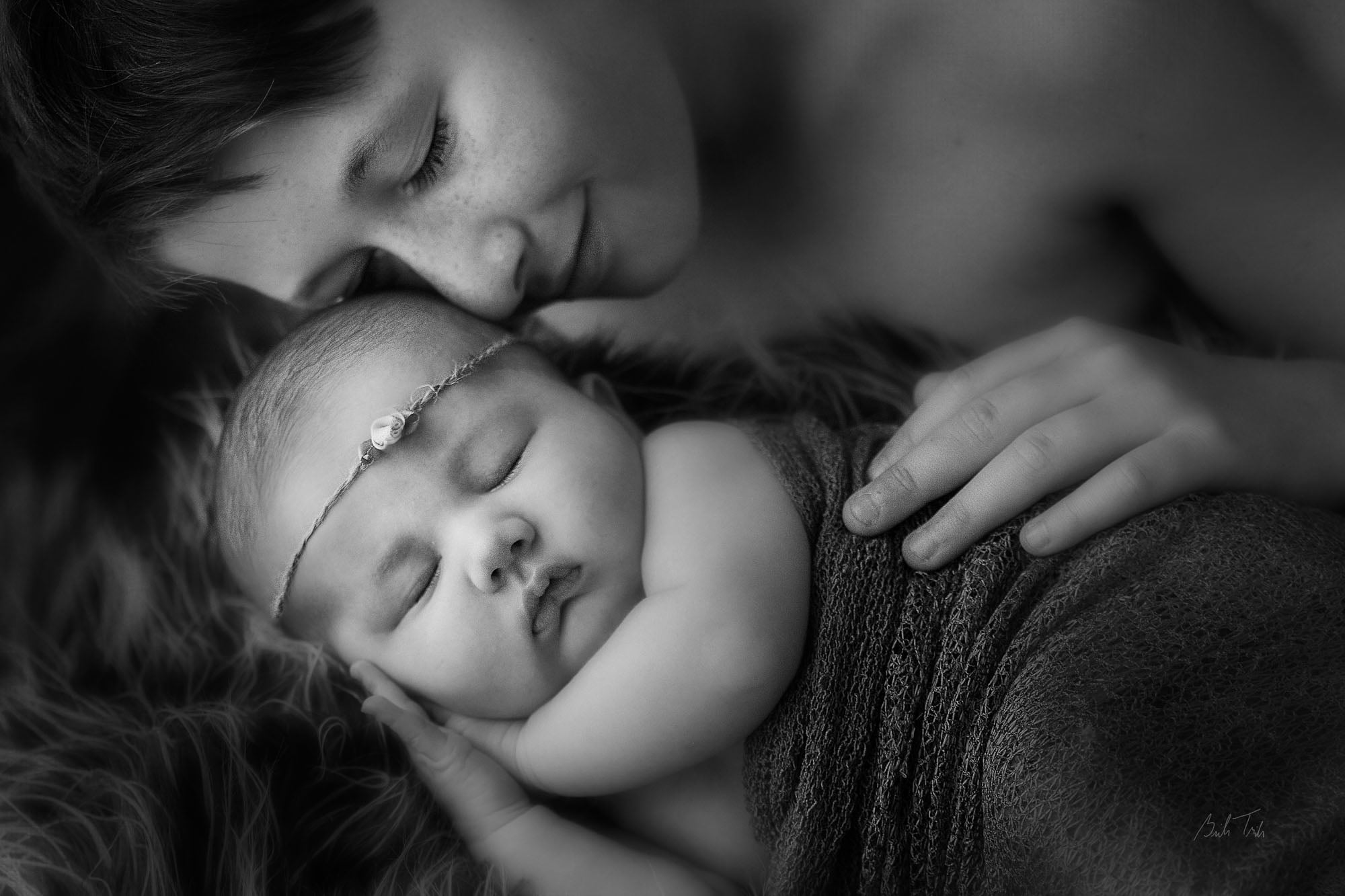
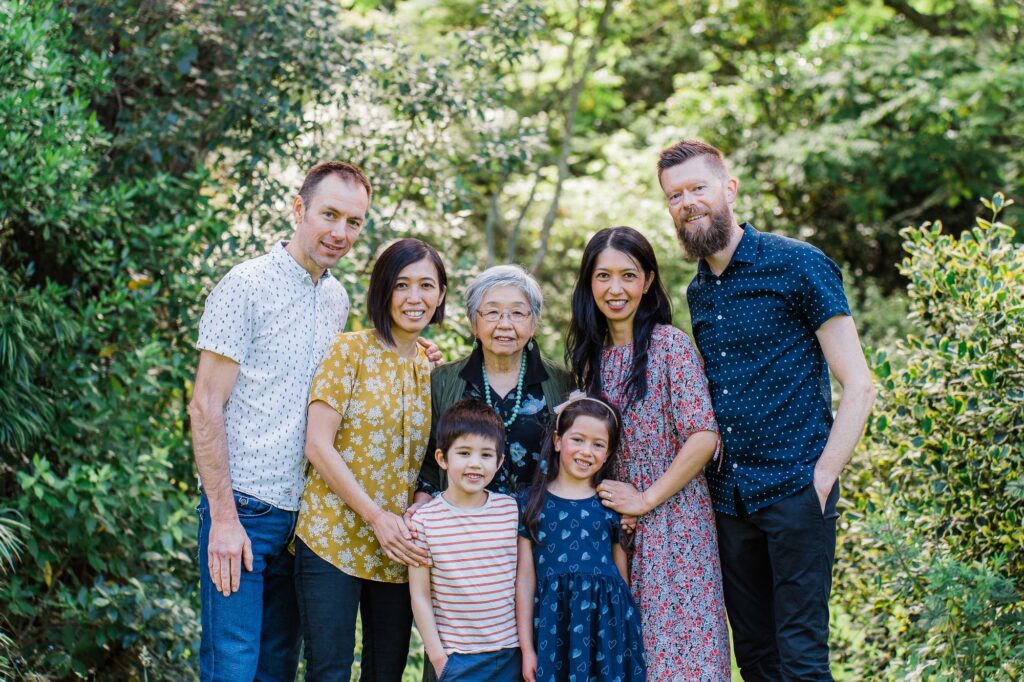
What we shoot at a full moon session is mostly people. The baby held against a shoulder. A grandmother’s hands under a head. Siblings leaning in from both sides. Close frames of an ear, a hand around a finger. The scale of a one-month-old against an adult chest is the thing that stops making sense to you a year later, and a photograph holds it.
The mother has been indoors for a month
Many Chinese families observe 坐月子 — the confinement month — where a new mother rests at home, eats specific foods, and avoids cold, wind and outings. Practice ranges from strict to fairly relaxed, and plenty of families in Sydney adapt it.
For the photography this has one large consequence. The full-moon session is very often the first time the mother has left the house, and sometimes the first time she has had her hair done in a month. That is worth saying plainly because it changes what she needs from us.
What we do about it: book late morning rather than early. Keep the studio warm. Build in a break. Ask before we photograph her at all, rather than pointing a camera and hoping. Some mothers want a full portrait with the baby that day; some want to be in two frames and no more. Both are completely reasonable, and a photographer who does not ask will get it wrong.
If travelling out is too much, we will come to you. A one-month session in a lounge room with one big window works perfectly well, because nothing about it depends on the studio setups.
Red eggs, and how to photograph them without it looking staged
If your family is doing red eggs, bring some to the session — a small bowl is enough. But do not let us photograph them as a still life on their own. A close-up of eggs in a bowl is a stock photograph, and in ten years it will mean nothing to anybody.
Photograph them being handled. A grandmother’s hands lifting one out. An older sibling holding one up next to the baby. The box at the table with people around it. What makes the image work is the connection between the object and the family, and the object on its own has none.
The same goes for any gifted clothing, a jade piece, or a red envelope. In the frame, in use, with a person.
What does the day of a full-moon session look like, hour by hour?
Families often ask for a walk-through, because the day also has a lunch or a house full of relatives attached. Here is a realistic shape, adjusted for a baby who is about four weeks old. Your own baby’s feeds will move everything.
Morning, before anyone arrives. Feed the baby first, then leave a little room before the session, so you arrive with a content baby rather than a ravenous one. Pack the traditional outfit, a plain wrap, a spare for the inevitable, and a bowl of red eggs if you are using them. Dress the baby in something that is easy to open at the front, because every change is a chance to wake them.
The first twenty minutes. We start with the baby and mum, before the relatives gather, while the room is quiet. A month-old reads tension from the arms holding them, and a hush helps. If the baby is asleep, we use it for the close frames of hands and feet and ears. If the baby is awake, we let them look around and work from a little distance.
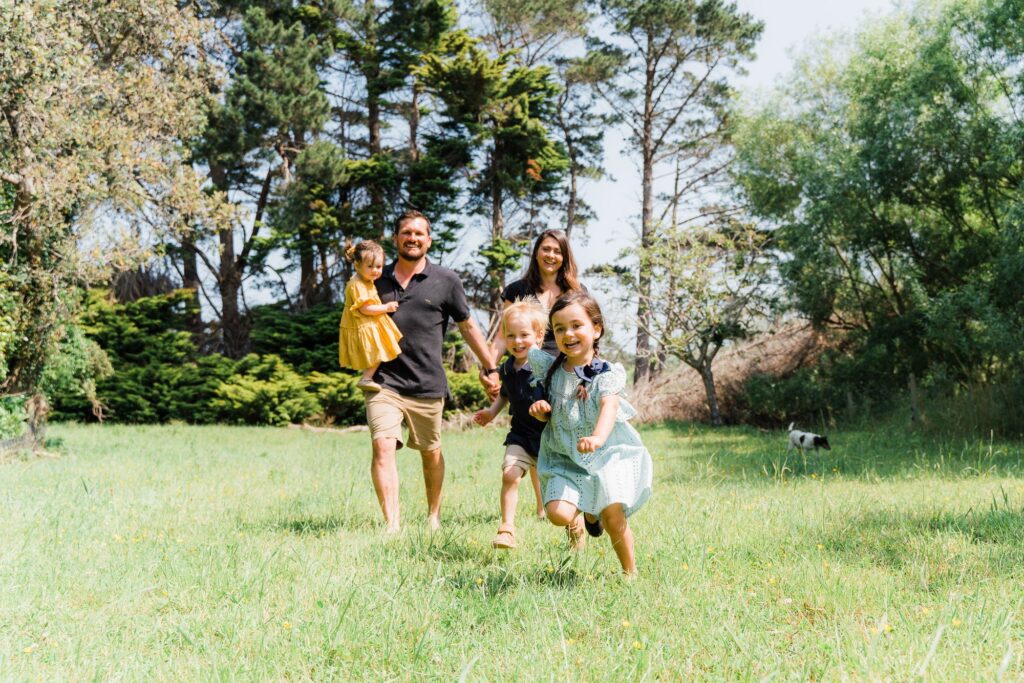
Midway. This is when grandparents and siblings join, one small group at a time rather than all at once. Everyone in at once means everyone talking at the baby, which tends to produce a furrowed brow and a cry. A grandmother and the baby, then the parents and the grandmother, then the siblings at the sides.
The last stretch. One frame with everybody who came, in front of the same window or backdrop, while the baby is as settled as they are going to get. Do that one near the end rather than at the start. If a feed is due, take the break before you try it.
How do I fit a large family into a session without losing the baby?
Full-moon days attract guests. If six or eight relatives come, the baby can become a prop in a group photograph. A few ways to avoid that:
- Stagger the arrivals. Ask extended family to come for the last third rather than the start, and let them stay for the lunch afterwards.
- Choose two or three people for one-to-one frames. A grandmother, perhaps, and the baby’s father’s mother or whoever matters most in your family. Everyone else goes in the group frame.
- Decide who holds the baby in the group frame ahead of time. Whoever it is should be sitting, so a heavy month-old is supported by lap and arm.
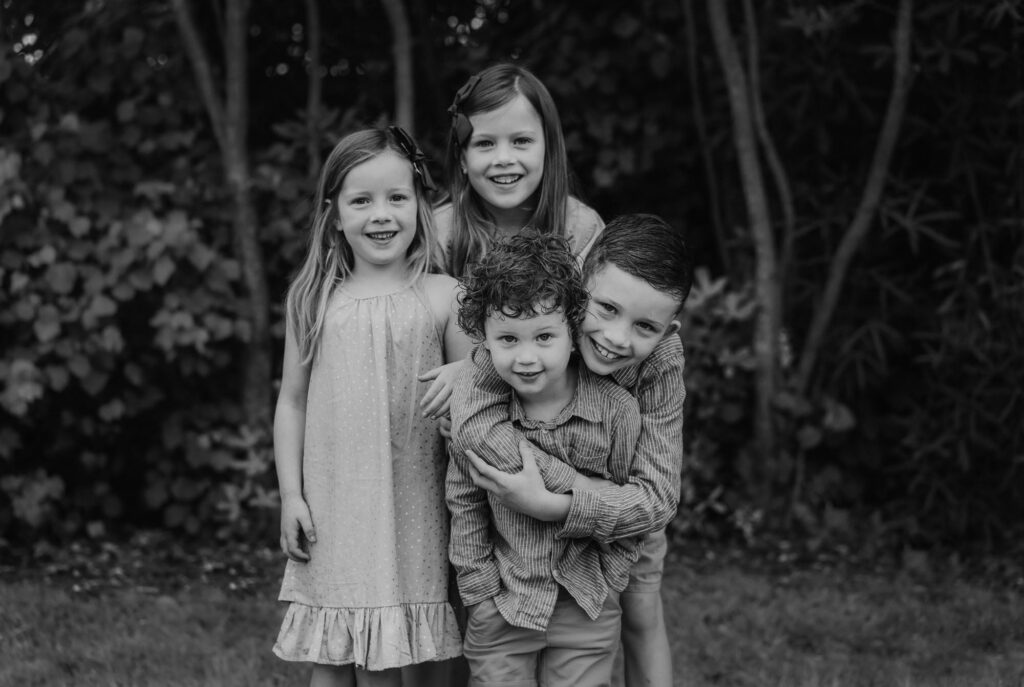
- Keep the older siblings close to the baby. Place them beside the seated adult rather than behind, so their faces and the baby’s are on the same level.
If the gathering is large enough that you are worried about all of them fitting into one frame, say so when you enquire. We would rather plan for the numbers than discover them at the door.
What should I prepare the week before?
Most of the preparation is small things that are easier to do the week before than the morning of. Use this list as a prompt and add what your family does.
- Confirm the date with your doctor or midwife’s advice in mind. How and when you go out with a new baby is your call, not ours.
- Tell us the baby’s date of birth and the number of guests.
- Decide whether the red eggs, ginger or any gifted items are coming, and who will hold them.
- Pick one outfit for the baby from relatives or tradition, plus a plain backup.
- Choose clothes for the adults in quiet colours, avoiding logos and busy prints.
- Write down the three people you most want in a frame with the baby.
- Plan feeds, so the baby is fed shortly before and ready for another break in the middle.
- Pack a muslin, a spare top for mum, and water.
One extra suggestion that costs nothing. Ask the oldest relative in the room to say the baby’s name and the date aloud while the baby is being held, even if nobody is filming. People forget what was said at a celebration within a few years, and a photograph taken during that moment is far more likely to hold your attention later than one of an empty chair.
When you print from a full-moon session, choose the frame in which the oldest and youngest faces are closest together. That is the picture you will hold up when your child asks who that is.
Common questions
How much does a full-moon session cost in Sydney?
Studios here generally charge $300 to $800 for a session at this age, depending on length and whether prints or files are included. A large multi-generation group usually needs extra time, so say how many people are coming when you enquire rather than on the day. Our own $295 Mini Love Sitting is the single figure we put in public, and it suits a small family group rather than a big gathering.
Can you photograph the celebration itself rather than a studio session?
We can cover a lunch or a gathering, but be clear about what that is. Event coverage gives you the day — the toasts, the relatives, the eggs going round. It does not give you a controlled portrait of the baby, because restaurant rooms are dim and orange and full of people. Families who want both usually do a short session in the morning and coverage after.
What should the baby wear?
Whatever your family has chosen. If there is a traditional outfit sent from relatives overseas, that goes in first and we shoot it properly. Then a plain wrap or singlet for the close frames, because at four weeks the photographs people keep are usually of skin and hands rather than clothing. Two outfits is plenty.
Is a full moon session different from a 100-day session?
Different occasion, different age, different photographs. A hundred-day baby holds their head up and smiles on purpose, which is a much more active portrait — we go through that separately in our guide to 100-day baby photos. If you are choosing between them, the full moon is the family one and the hundredth day is the baby one.
We are not Chinese. Is a one-month session worth booking?
Yes, and we photograph plenty of them without any celebration attached. Four weeks is a good age for awake, eye-open, in-arms photographs, and it is the natural fallback for families who missed the newborn fortnight.
Red eggs, everyone in the room, and one thing on the wall
What a full moon is really about is the introduction — a month of waiting, and then a room full of people who finally get to hold the baby. The photographs that survive from it are the ones with those people in them, not the ones with the props.
So our advice is narrow. Get everybody who came into one frame. Photograph the eggs in somebody’s hands. And print one image large enough to live on a wall, because a full-moon gallery sitting in a phone gets scrolled past for a fortnight and then never again.
If the month is nearly up, email info@tzportraits.com with the baby’s date of birth and how many people are likely to come. We will tell you honestly whether to do one session or two, and we will say so even when the answer is the cheaper one.
Portraits in and around Epping
Our studio is in Epping, and we photograph across Sydney.