Short answer: A safe newborn session has a hand on the baby at all times, uses composite editing for any pose where the baby appears unsupported, keeps the room at about 26 degrees, and never puts a baby anywhere they could roll or fall. If a photographer cannot explain how the froggy pose is made, walk away.
Newborn photography has an unusual problem. The images that get shared most are the ones that are riskiest to make, and the technique that makes them safe is invisible in the final photograph. So parents see a baby with its chin resting in its own hands, assume it is a pose the baby holds, and end up in a room with someone who is trying to recreate it for real.
This one is worth reading properly. We are not going to soften it.
The froggy pose is two photographs, always
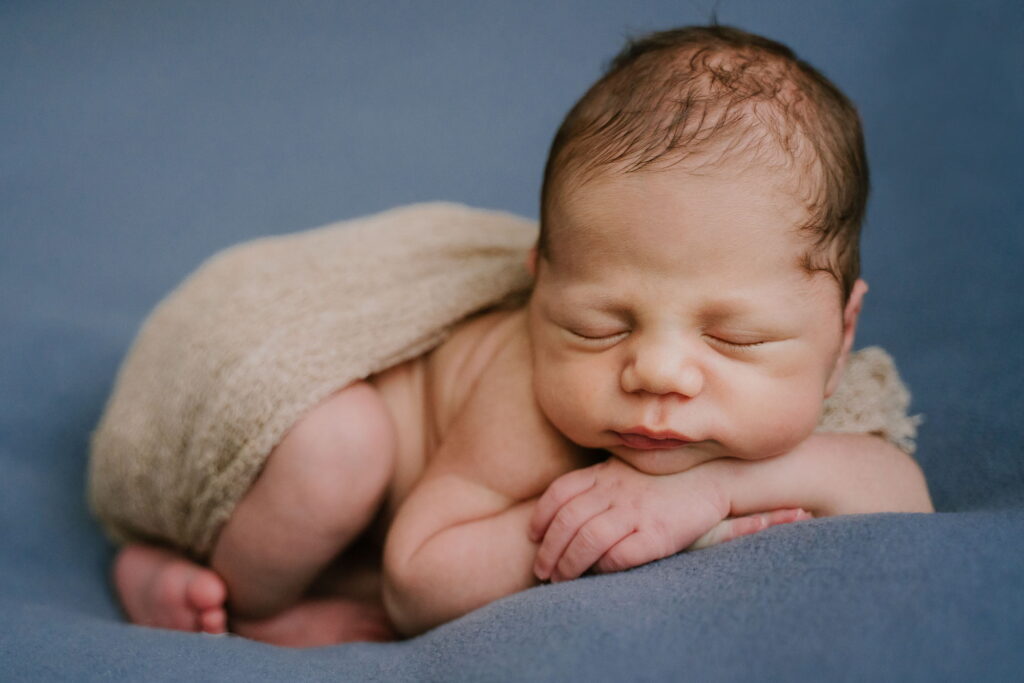
You know the image. Baby face-on, elbows out, chin resting in both palms, bottom up. It is the single most requested newborn shot in Sydney.
A newborn cannot support its own head. Not at five days, not at fifteen. That pose is never held by the baby. It is made as a composite: one frame where an adult supports the head and wrists, a second frame where an adult supports the body from behind, and the two are merged in Photoshop so the supporting hands disappear.
That is the correct method and it is the only correct method. A photographer who props a baby’s chin on its own hands and steps back to shoot is risking the baby’s airway and neck, in a person who cannot tell you they are in trouble.
Ask directly: do you composite the froggy pose? The right answer is immediate and specific — yes, two frames, hands in, merged afterwards. Hesitation, or “we only do it if the baby is settled”, is a no.
Spotter hands, and why there are two adults in the room
A spotter is a second pair of hands on the baby whenever the baby is on anything raised, in anything, or in a pose with any load on it. Usually a parent, sometimes an assistant. In our studio it is one of us and one of you, and we will ask you to stay close rather than sit down.
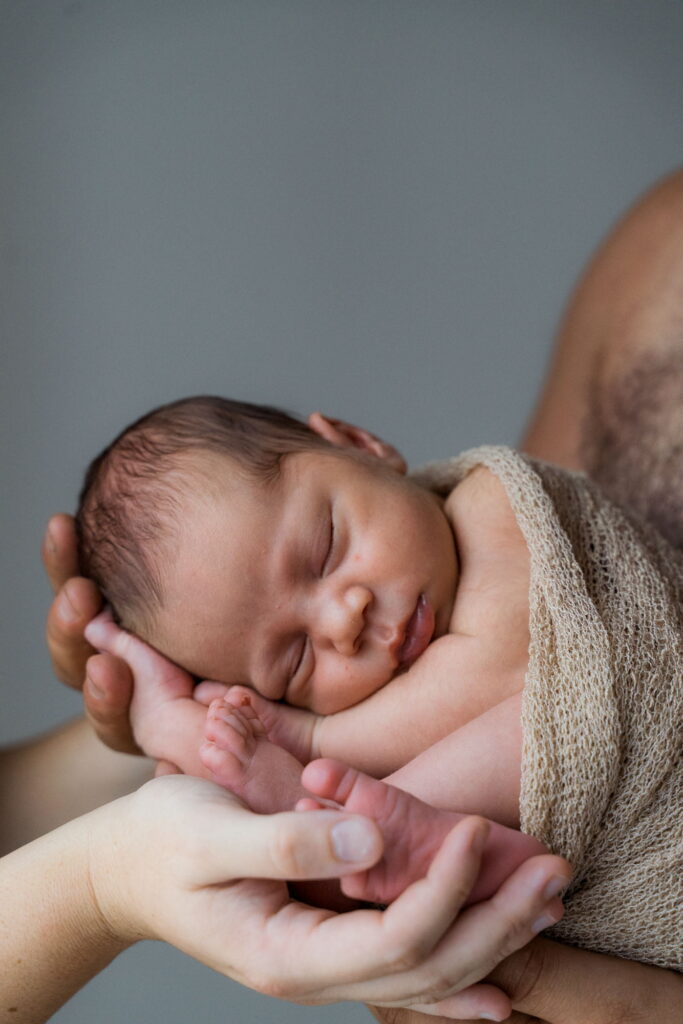
You should see this happening. If a baby is in a bowl, a bucket, a crate, on a bed of blankets or in a hammock-style prop, an adult’s hand should be inside or touching the frame for the entire shot, and that hand is removed in editing later. Hands come out of the picture in Photoshop, not in the room.
The hanging-in-a-sling shot deserves its own warning. Any pose where a baby is suspended from a branch or a hook is composited — the baby is photographed supported and low, the empty prop is photographed separately, and they are combined. Nobody should ever actually hang a newborn.
Warmth, and what happens when a studio is cold
Newborns cannot regulate their own temperature. Undressed, in a room at normal temperature, they get cold quickly, and a cold baby will not settle into any pose — which is the moment an impatient photographer starts pushing.
A newborn studio should be at 25 to 27 degrees, uncomfortably warm for the adults in it. We run a heater, and Sydney winter sessions mean we are all in t-shirts. Ask what temperature they work at. If the answer is vague, the sessions are short for a reason.
The opposite failure matters too. Heat packs and heating pads used under a baby must be switched off before the baby goes on them, and checked by hand. A warm surface is right. A hot one burns skin that is days old.
Hygiene, illness and the things worth asking about
- Hands and sanitiser. Before every setup, every time, including yours.
- Wraps and fabrics washed between families. Not spot-cleaned. Washed. A busy studio goes through a lot of laundry and that is exactly as it should be.
- Nobody sick in the room. That includes the photographer, an assistant, and the older sibling with a runny nose. A newborn under six weeks with a fever is an emergency department visit, so this is not fussiness. If we are unwell we move your session, and we would ask you to do the same.
- Vaccination status of the studio. Fair to ask about whooping cough. Plenty of Sydney studios keep their pertussis boosters current and will tell you so.
- No jewellery, short nails. Small thing, easy to check, and you will notice it immediately.
Props: what is fine, what is not
| Safe as shot | Composite only | Avoid entirely |
|---|---|---|
| Baby on a beanbag, wrapped, flat | Froggy pose (chin in hands) | Any prop suspended above the floor with a baby in it |
| Baby in a parent’s arms | Baby in a sling or hammock | Glass, ceramic or anything that chips or cracks |
| Low bowl or crate on the floor, spotter hand in | Sibling holding baby unsupported | Baby on a raised table without a spotter |
| Wrapped poses, hips loose | Head-on-hands variations | Tight swaddling around the hips |
That last one gets missed. Wrapping should leave the hips and knees able to bend and spread. A wrap pulled tight and straight down the legs is a hip dysplasia risk, and it is not necessary for the photograph.
Bending, forcing and the rule we work by
A newborn goes where a newborn goes. If a baby’s arm does not fold into a position easily, that position does not happen that day. There is no pose worth forcing a joint for, and an experienced photographer has ten alternatives ready.
Watch for this in the room. Gentle, patient repositioning, waiting for a stretch to pass, going back to a settled pose when the baby objects — that is the job. Persistent manipulation of a baby who is fighting it is not, and you are allowed to say stop. It is your baby. You will never be the difficult client for saying so.
Insurance, and why it is a safety question
Public liability insurance does not make a baby safer by itself. What it tells you is that the photographer runs a real business, has been asked real questions by an insurer, and has something to lose. Ask for the certificate if you like; a professional studio will send it without blinking.
Ask about first aid too. Infant CPR training is not universal among Sydney newborn photographers and it should be. If you are still comparing studios, our guide to choosing a newborn photographer in Sydney covers the rest of the shortlist.
What should I look for in the first ten minutes of a session?
You do not need photography experience to judge whether a newborn session is safe. Watching how the room works tells you most of what you need to know. These are the observations we would make if we were in your seat, and none of them requires a confrontation.
First, where are the photographer’s hands when the baby is moved? A careful photographer supports the head and the bottom together, moves slowly and keeps a hand on the baby until they are settled. A rushed one lifts with one hand and lets go too soon.
Second, how does the photographer react when the baby fusses? Calm is the correct response. A pause, a feed, a cuddle, a change of plan. Visible impatience is a red flag, because impatience is what leads to forced poses.
Third, who is watching the baby when the photographer steps back to shoot? Somebody must be. If the answer is “nobody, they are fine on the beanbag”, that is the moment to say you would like to hold the baby.
Fourth, is there somewhere for you to sit and watch? A studio that is relaxed about parents being close has nothing to hide. If you are asked to wait in another room, ask why.
What should I tell the photographer before we arrive?
A good photographer wants more information than you think they will, and the more they know, the safer the session. Tell them anything your doctor, midwife or child health nurse has said about your baby. Examples: reflux, a tongue tie, a hip check still to come, a baby who needs positioning after feeds, or any advice to avoid certain positions. We follow that advice over any pose.
Mention how your baby has been feeding and sleeping. A baby who has had a rough night is more likely to need a slow, patient session, and we would rather know before we start than discover it with a baby on the beanbag.
Tell us how you are feeling too. Birth recovery is real, and a parent who is exhausted, sore or unwell should not push through for the sake of a booking date. If you are not up to it, we move the session. For anything about your baby’s health, your own doctor or midwife is the authority, not a photographer.
When should we stop?
Pause the session if your baby shows any of the following, and call your doctor or midwife if you are worried:
- Colour change, especially around the lips or face
- Laboured or unusual breathing
- Limpness, or a baby who is hard to rouse
- Inconsolable crying that does not respond to feeding or holding
- Feeling too hot or too cold to the touch
We stop for all of these and we do not care what time is left on the booking. You are allowed to stop too, at any point, without giving a reason.
A checklist to take to your enquiry
- Ask how the photographer makes the poses where the baby appears to be supporting its own head
- Ask who is spotting the baby while the photographer shoots
- Ask what temperature the room is kept at
- Ask what happens if the baby is unwell on the day, or if a family member is
- Ask whether the photographer holds current first aid training for infants
- Ask whether fabrics are washed between families
- Ask what happens if the baby needs a long break
- Tell them about any medical advice you have been given
If you are comparing several studios, our guide to how to choose a newborn photographer in Sydney goes through the rest of the shortlist.
Finally, bring your instincts. In the studio, the loudest alarm bell is the one that goes off in your own head when something looks wrong. If your stomach tightens at what you are watching, say “can we stop and I will hold him?” That sentence is always acceptable, and a photographer who minds it is not one you want near your baby.
Common questions
Is it safe to photograph a newborn at only five days old?
Yes, with the precautions above, and the first two weeks are when babies curl most easily. Age is not the safety variable — supervision, warmth and handling are. What matters more is that the baby is feeding well and that you feel up to it. We would rather move a session than have an exhausted family push through.
Can my toddler hold the baby for a photo?
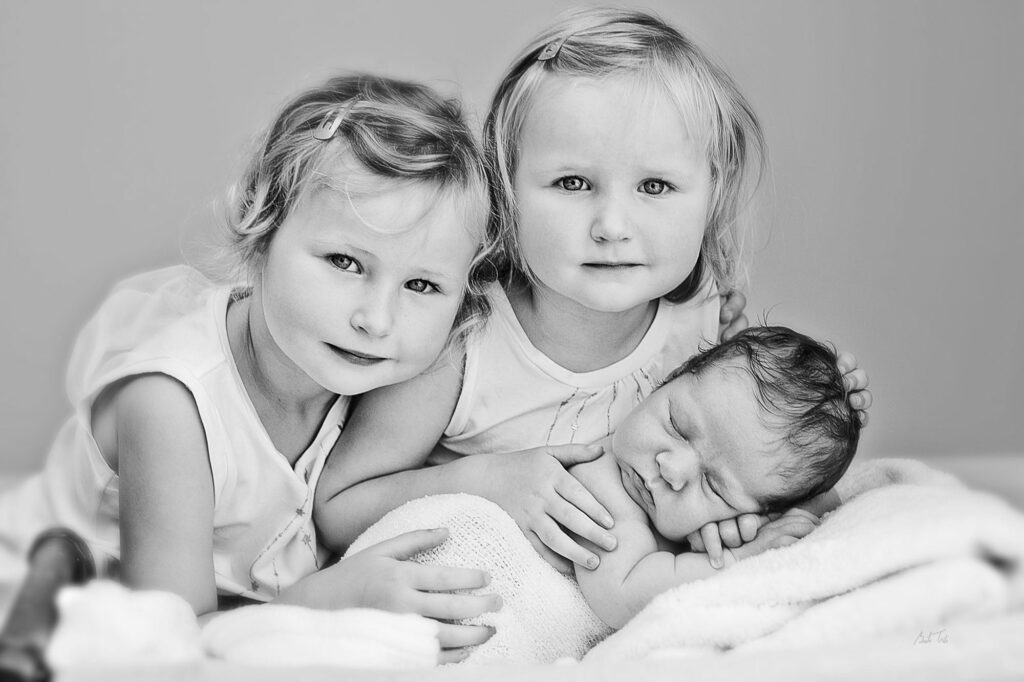
Sitting down, backed by cushions, with an adult’s hands right there, yes. Standing, or unsupported, no — and any image that looks like a small child holding a newborn alone was almost certainly composited. We arrange the sibling shot first, while everyone has patience left.
What if my baby will not settle and we get through very few poses?
Then we get through few poses. That is a normal session, not a failed one, and the alternative is pushing a baby who has told you no. Most families print two or three images anyway. A photographer who treats an unsettled baby as a problem to be solved rather than a schedule to be changed is the risk here.
Are composites dishonest?
No, they are the standard of care. Every reputable newborn image you have seen with a baby appearing unsupported was made with hands in the frame and removed afterwards. Ask any photographer to show you the before frames. Being happy to show you is a good sign in itself.
Should I stay in the room the whole time?
Yes, and any studio that discourages it has answered a question you did not need to ask. Parents are also the best spotters we have, because you already know how your baby moves.
Two questions that sort the field
You do not need to audit anyone. Ask two things when you enquire: how do you make the froggy pose, and who is spotting while you shoot? Someone who works safely answers both in about fifteen seconds, in detail, without being defensive, and usually seems pleased you asked.
Anyone who gets vague, or tells you their babies are just very settled, has told you what you needed to know.
Ask us the same two questions. Email info@tzportraits.com, and we will also send you the unedited frames behind a finished composite so you can see exactly where the hands were.
Newborn portraits in our Epping studio
A warm, quiet studio, plenty of time and your baby's pace. Parents and siblings are welcome in the frame.