Short answer: No, it is not too late. After about four weeks the tightly curled sleeping poses become difficult, but a five or six week old gives you something a five day old cannot — open eyes, focus, and the first flickers of expression. Many parents prefer those photos.
Almost every parent who asks us this has already decided they have failed at something. They have not. The industry created that deadline, we all repeated it, and it is only half true.
What is actually different at five weeks
It is physical, and it is worth understanding rather than just being told.
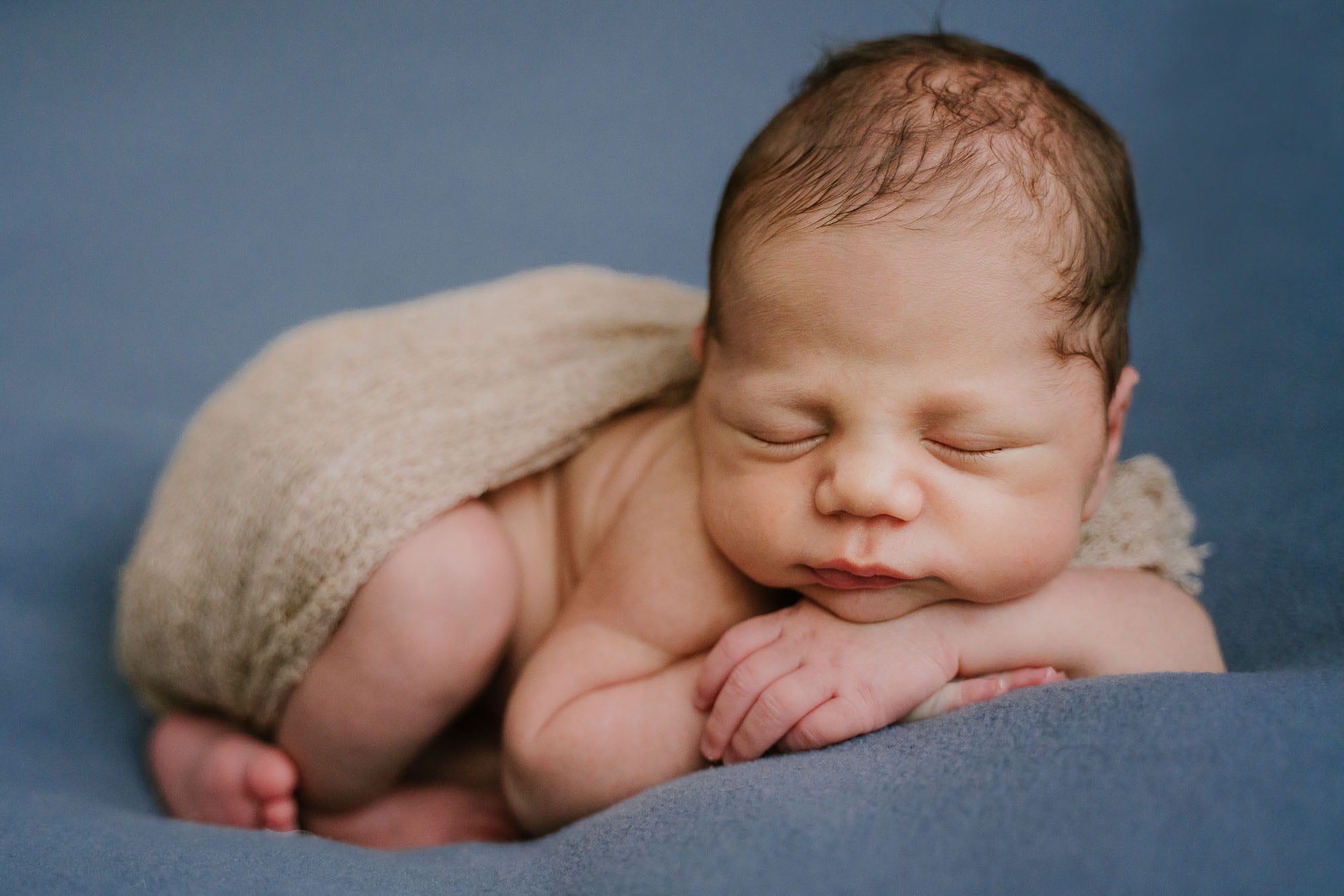
A baby in the first fortnight still holds the shape they held in the womb. Knees up, chin down, hands near the face. They also sleep through being moved, because the startle reflex has not sharpened up yet. That combination is what makes the classic curled-in-a-bowl photo possible — not skill, biology.
By four to five weeks, three things have shifted. The limbs have started to straighten out and a baby will actively push a leg back down. Sleep has become lighter, so lifting a hand wakes them. And the digestive system has woken up, which for many babies means the evening unsettled period has begun. None of that stops a photo happening. It stops one particular kind of photo happening easily.
What you gain instead
Eyes. Real, open, focused eyes that track a face about thirty centimetres away.
A newborn in week one opens their eyes for a few unfocused seconds. At five to six weeks they will hold a gaze, and somewhere in that fortnight the first social smile arrives — the one that is a response to you, not wind. Photographing that is a completely different afternoon. The baby is a participant.
The skin is usually better, too. Weeks two and three are peak baby acne and peeling for a lot of babies, and by five weeks that has often settled. Jaundice colouring has gone. Birth marks have faded. We retouch all of it, but starting from clearer skin is a real advantage.
Week by week, honestly
| Age | What it is good for | What is harder |
|---|---|---|
| 5–10 days | Deepest sleep, tightest curl, full range of wrapped and posed work | Mum’s recovery; skin often still blotchy; no awake frames |
| 11–16 days | Still curls well, feeding usually established, calmer parents | Peeling and baby acne peak around here |
| 3–4 weeks | Some curled poses still work; short awake windows appear | Lighter sleep, more resettling, slower session |
| 5–6 weeks | Open eyes, first smiles, clearer skin, real expression | Posed curled shots largely off the table |
| 7–10 weeks | Strong eye contact, bigger smiles, lovely parent-and-baby frames | Looks like a baby, not a newborn — and that is fine |
The sessions that get booked late, and why
Nobody arrives at six weeks because they were casual about it. The reasons we hear are: a NICU or special care stay, a hard birth and a slow recovery, reflux or feeding problems that swallowed the first month, twins, a mother with no help at home, or simply not knowing that newborn sessions were a thing until a friend mentioned it.
There is also the perfectly reasonable group who spent the first month surviving and only started thinking about photographs once they surfaced. That is most people. If a photographer makes you feel careless for that, find another photographer.
How we shoot a six-week-old differently
We stop trying to make them asleep and build the session around them being awake.
That means more parent-and-baby frames, because a baby who can focus will look at a parent’s face and that connection is the photograph. It means simpler setups — a bed, a blanket, good light — rather than a sequence of prop changes. It means shorter, because an alert six-week-old gives you a good ninety minutes, not three hours, and pushing past that just produces crying.
It also means we shoot faster during the alert-and-calm window, which is usually thirty to forty minutes after a feed. Before that they are drowsy, after that they are done. Book mid-morning, feed on arrival, and we work to that clock.
What does not come back
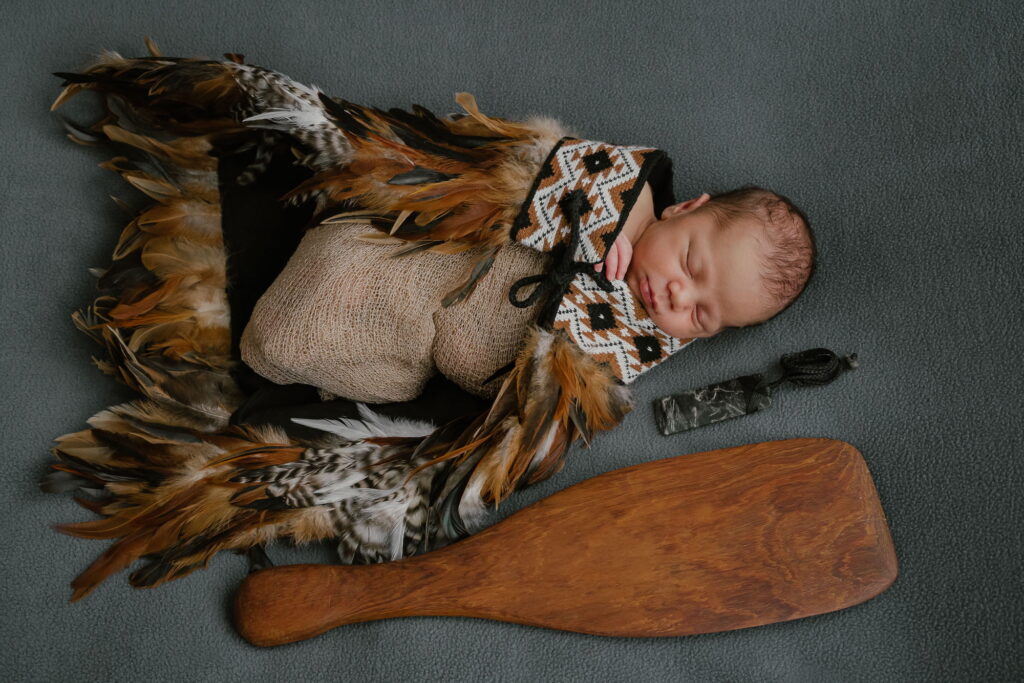
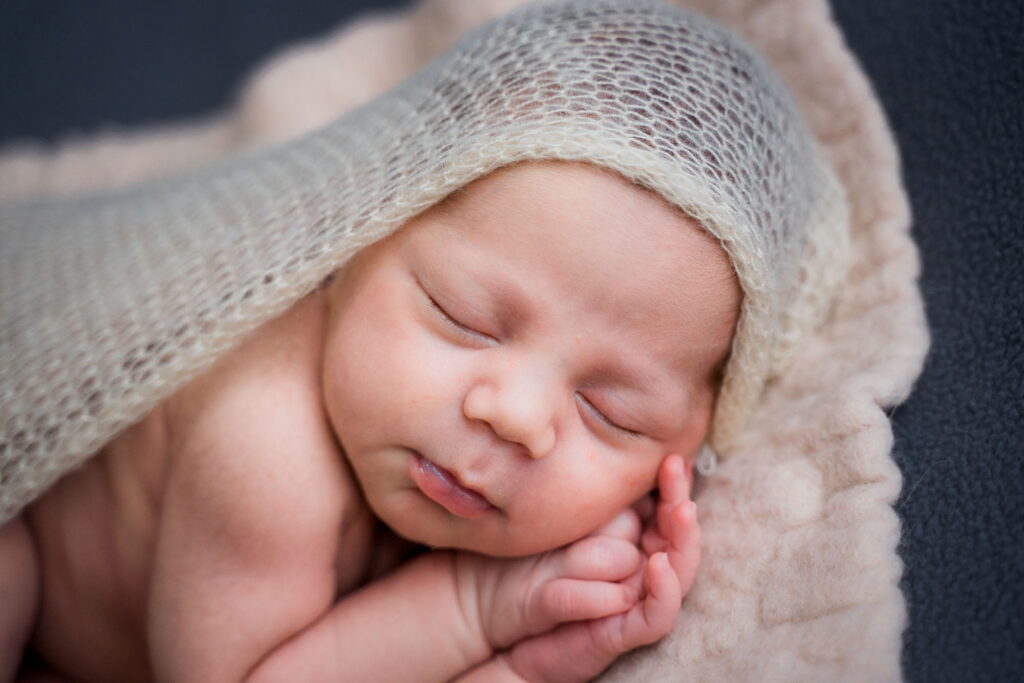
We should be straight about this rather than sell you reassurance. Past about three weeks, expect to lose: the froggy pose with chin on hands, the deep bowl and basket curls, the tight potato-sack wraps, and most composite setups. Those depend on a baby who stays folded and does not wake when moved.
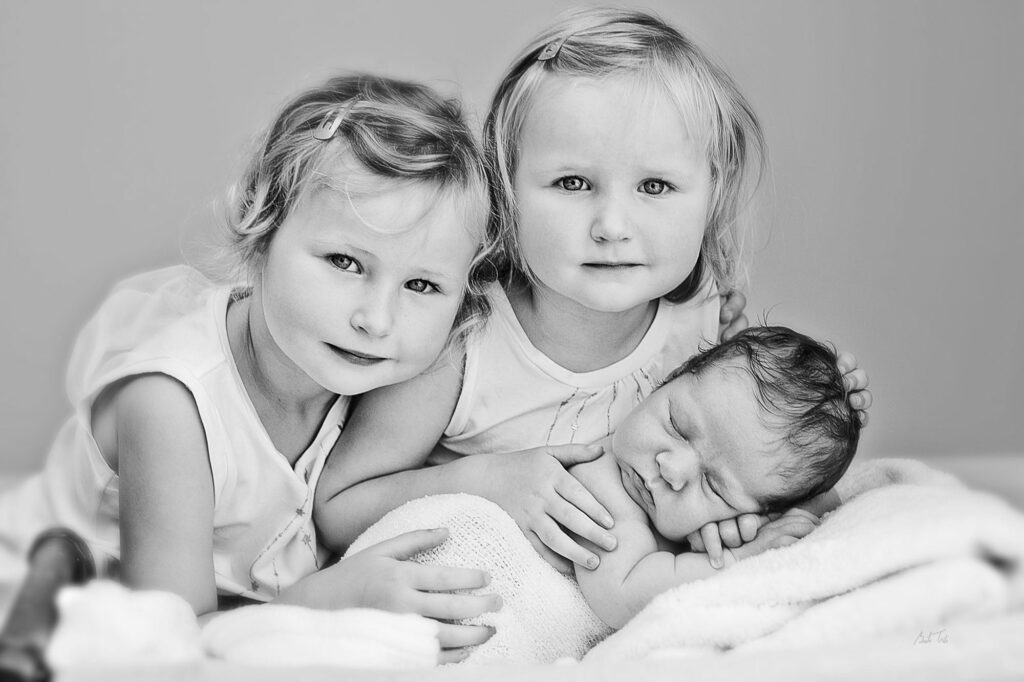
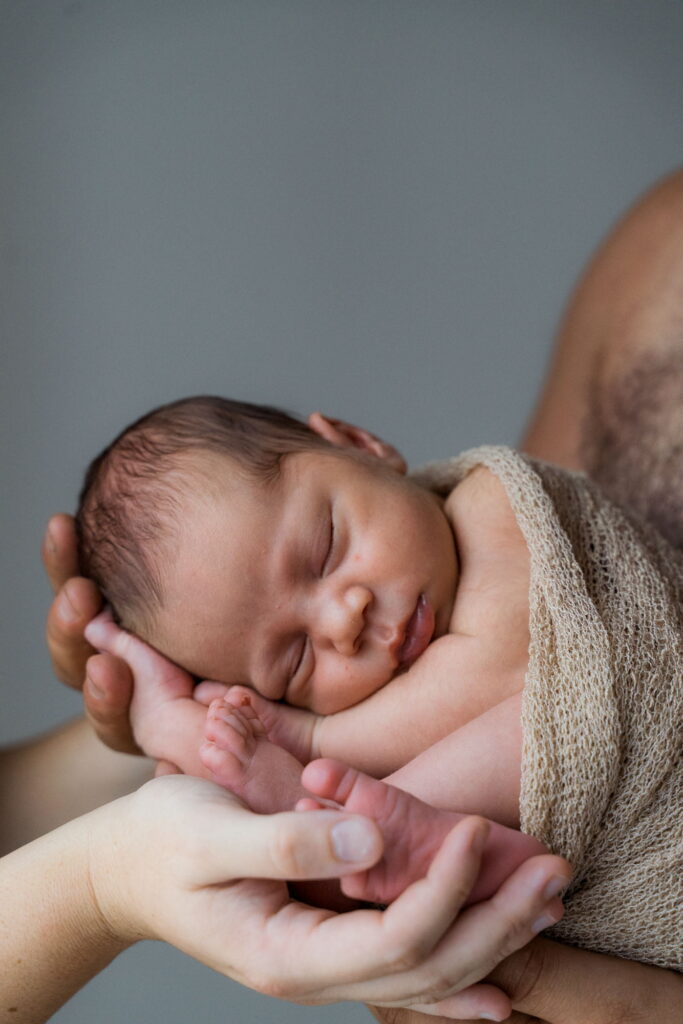
If those specific images are the ones you have pinned, and your baby is three weeks old, book in the next few days rather than in a fortnight. Anything that requires a spotter and a merged frame also has a safety argument attached to it, which is covered in newborn photography safety. Everything else — wrapped frames, parents’ hands, feet and fingers, family portraits, sibling shots — works at any age in the first two months.
If you are pregnant and reading this early
Book your session around your due date, not around the birth. The usual booking pattern is to hold a window in your thirties weeks and move it once the baby arrives, which is how photographers handle babies who come at 38 weeks or at 42. That is set out in when to book a newborn session.
But hold this lightly. If the first month goes sideways — and it does for plenty of families — a later session is not a consolation prize.
How do I get a six-week-old ready for a session?
An older baby is a participant, and that changes what you do beforehand. The aim is to arrive with a baby who is fed enough to be content and awake enough to look around.
Time the feed so it ends roughly thirty to forty minutes before the shoot, then keep the baby up in the car if you can. Most babies fall asleep in a moving car seat, which is the opposite of what we want. If the drive is short from Eastwood or Ryde, a sleepy baby wakes on arrival and the warm, bright room often does the rest. For a longer drive, a stop for a calm top-up feed near the studio works better than one at home.
Bring a spare outfit, since six-week-old digestion has opinions. Bring a dummy if your baby uses one, and tell us before it appears so we are ready for it. If your baby is only comfortable being carried, that is fine. We photograph the carrying.
Expect the first ten minutes to be quiet. We look at how your baby reacts to the light, which side they turn towards, whether they stare at a particular face. That information shapes everything after it.
What can a parent do during the session to get real expressions?
A baby this age watches faces, so a parent standing just beside the camera is the best tool in the room. A few things that work:
- Talk in a low, slow voice, the one you use at 3am. High, excited noises tend to startle.
- Keep your face about a forearm’s length from the baby’s, which is roughly where they see best.
- Sing something short, even badly. The rhythm settles them more than the tune.
- Leave a gap after each sound. Babies respond a second or two late, and the response is the picture.
- Stay calm if there is crying. A pause, a cuddle and a feed reset the session, and the frames after a settle are often the best of the day.
Parents often apologise for crying. Please do not. A baby who cries is behaving exactly as a baby of that age should, and the next quiet minute is when we work.
Which session suits my baby’s age?
If you are still unsure, use this as a rough decision guide.
| If your baby is… | And you want… | Then |
|---|---|---|
| Under about two weeks | Curled, sleeping frames | Book as soon as you can, before the window closes |
| Around three weeks | Some of both | Book in the next few days and plan for a mix of asleep and awake |
| Four to six weeks | Eyes, first smiles, parents holding baby | Book an awake session and keep it short |
| Seven weeks or older | Strong eye contact and personality | Take your time. A slightly later session can be easier, and it still has plenty to offer |
If your baby was born early or spent time in special care, the dates above shift. Talk to your doctor or midwife about when you feel ready to have visitors in your home or a trip out, and then tell us the gestation when you book. We would rather wait for you than hurry you.
A checklist for the week before
- Pick the time of day your baby is calmest and book for then
- Plan the feed to finish thirty to forty minutes before the session
- Pack two outfits and a spare for you, because spit-up is nobody’s fault
- Choose plain, soft clothes for parents, without large logos
- Trim the baby’s nails the day before, so there are no scratches to retouch
- Bring a dummy, a favourite muslin and anything that helps them settle
- Tell us about any skin issues so we can plan lighting around them
- Decide who else is coming, and how long they can wait
The photograph we hear about most from families of older babies is rarely a pose at all. It is the moment a six-week-old catches sight of dad’s face and gives a slow, lopsided half-smile that lasts about a second. Have dad ready, and keep your own phone out of reach so you do not miss it with your eyes.
Common questions
Is eight weeks too late?
Not too late for photographs, but call it a baby session rather than a newborn one. At eight weeks you get strong eye contact, proper smiles and beautiful frames with parents. What you will not get is anything that relies on curling or deep sleep. Set your expectations there and you will love the results.
Do photographers charge differently for an older baby?
Generally not — the Sydney market prices by the session, not the baby’s age. Some studios do run a shorter, lower-priced sitting for awake babies simply because it takes less time. Ask what the fee covers and how long it runs, rather than assuming the two are the same product.
Will my baby smile on camera at six weeks?
Often, and usually at a parent rather than at us. We tend to have mum or dad stand just beside the lens and talk. If the smile does not arrive, an alert calm gaze is just as good a photograph — arguably better, because it does not date.
My baby was premature. Which age do I count?
Corrected age, roughly. A baby born at 34 weeks often still curls and sleeps deeply at five or six weeks old, behaving much like a fortnight-old term baby. Tell us the gestation and we will work to that rather than the date on the birth certificate.
Can we still do a family photo if we missed the newborn window entirely?
Yes, and many families are better off doing exactly that. A session at three or four months, when a baby can hold their head up and laugh, is an easier and often happier morning than a rushed newborn one. It is a different photo on the wall, not a lesser one.
So what should you book?
If your baby is under about two weeks and you want the curled, wrapped, sleeping look, book now and read the session checklist while you wait.
If your baby is already four, six or eight weeks old, book an awake session and let go of the pose gallery you saved on Instagram. You will get eyes, expression and the beginning of a personality — and in fifteen years, when your child looks at that photograph, the thing they will recognise is the face, not whether the knees were tucked.
Tell us how old your baby is and what the first month has been like, and we will tell you plainly what that age can give you. Nobody here is going to make you feel late.
Newborn portraits in our Epping studio
A warm, quiet studio, plenty of time and your baby's pace. Parents and siblings are welcome in the frame.