Short answer: Photograph the siblings with the baby in the first twenty minutes, before anyone gets bored. An older child has roughly one good stretch in them. Spend it on the picture you actually want, then let them eat, play or go home with a grandparent.
We have three kids. When our youngest was born, our eldest was seven and our middle one was three. The three-year-old is the reason this article exists.
Every parent who books a session with an older sibling asks us the same thing in the enquiry email: will she sit still? The honest answer is that she will sit still for about ninety seconds, twice, and the whole session is built around catching those two windows.
Why the sibling shot has to be first
Newborn sessions run long and slow on purpose. The baby needs settling, feeding and re-settling. That rhythm is fine for a baby. It is torture for a three-year-old in an unfamiliar room with lights and a stranger holding a camera.
So we invert the order. The siblings come in, we photograph them with the baby straight away, and we do not wait for perfect. We shoot while the older child is still curious about the room rather than sick of it. Twenty minutes in, the interesting part has worn off and you are negotiating. Nothing good is photographed during a negotiation.
Once we have the sibling frames, the older child is released. That is the part parents do not expect and the part that makes the day work.
What to do with the older child afterwards
Bring somebody. A grandparent, an aunt, a friend, your partner if they are not needed in the frames. Their job is to take the older child out once the sibling photos are done, so you can settle into the rest of the session without one ear on a bored kid.
Our studio is in Epping, and there is a park a few minutes away that has absorbed a lot of restless three-year-olds over the years. Eastwood is close enough for a babycino run. Either beats forty-five minutes of “can we go now” behind the photographer.
If nobody can come, tell us when you book. We plan a shorter sibling block and we do not schedule the session over a nap.
Age changes everything
The sibling age is the single biggest variable in how a newborn session with older kids runs. Roughly, this is what we see.
| Sibling age | What actually happens | What we plan for |
|---|---|---|
| Under 2 | Wants to touch the baby’s face immediately. No concept of gentle yet. | Parent’s hands in every frame, often cropped out later. Very short block. |
| 2–4 | Enthusiastic, then done. Sudden and total loss of interest. | First fifteen minutes, one setup, no costume changes. |
| 5–7 | Wants to help. Can hold the baby seated with support. | Give them a job. They perform better with a task than an instruction. |
| 8+ | Self-conscious. Hates being told to smile. | Photograph them looking at the baby, not at us. |
The pose that works with almost every sibling
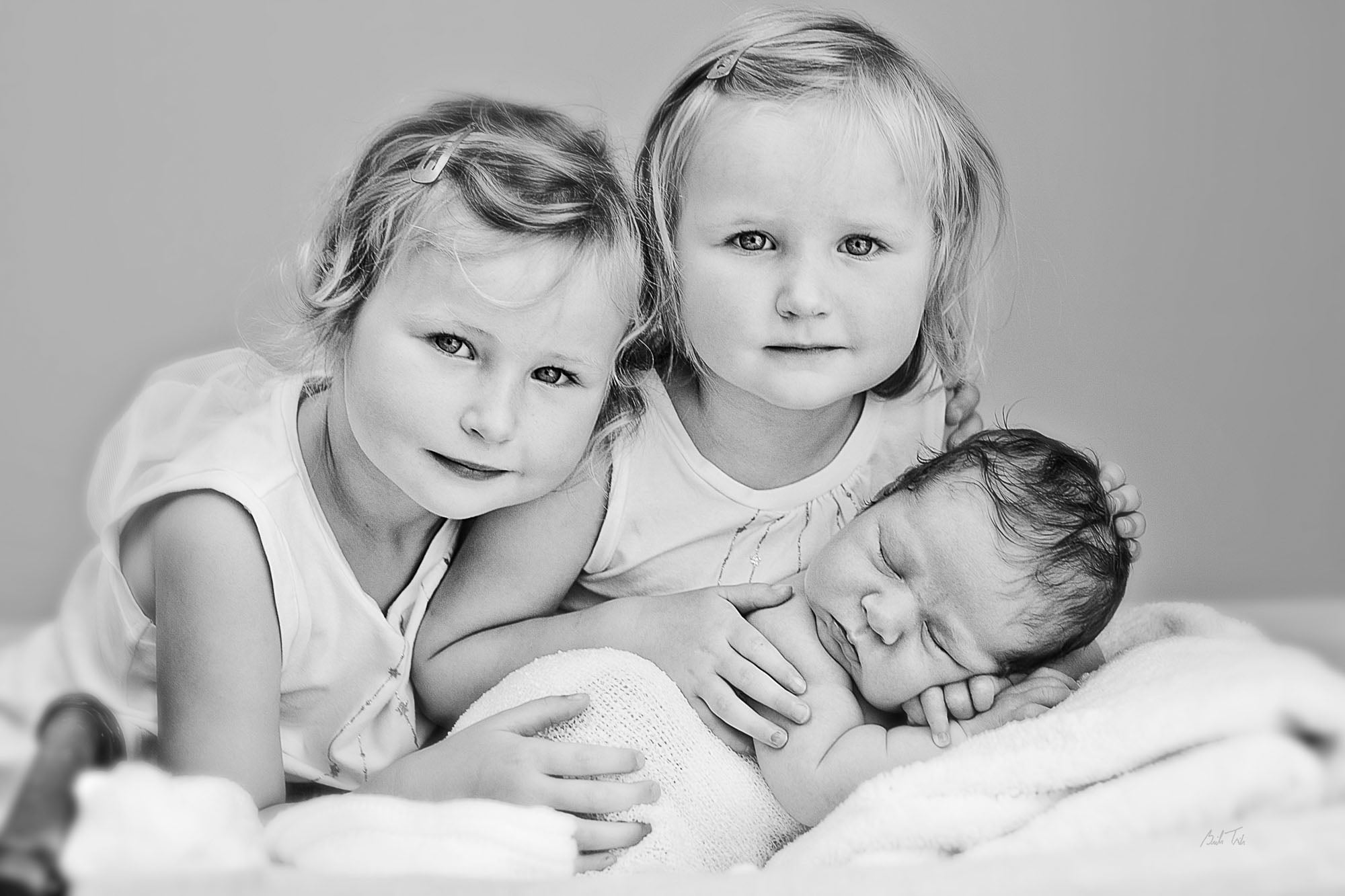
Older child sits cross-legged on the floor with their back against something solid. We place a pillow across their lap, the baby goes on the pillow, and a parent kneels just out of frame, never letting go of the baby.
It works because the older child is not being asked to balance anything. Their whole job is to sit and look down. Looking down at a new sibling produces a real expression, which is more than you get from asking a five-year-old to look at the lens and be happy.
We shoot that setup from above, then from the side, then close on their hands. Three genuinely different photographs from one arrangement, which is the whole trick when your subject has a ninety-second attention span.
Do not promise them anything you cannot deliver
Parents often prime an older child with a big promise on the drive over. Ice cream if you are good. A toy afterwards. It sounds harmless and it usually backfires, because the child spends the session asking when the reward arrives rather than being present.
What works better is telling them what is going to happen, in order, in plain words. You are going to sit down, you are going to hold your brother, we are going to take pictures, then you are finished and you can play. Children handle a known sequence much better than a vague bribe.
We also never ask a child to kiss the baby. You can see the difference between a kiss a toddler decided to give and one they were told to give, and so can everybody who looks at the photograph later.
When the older child refuses outright
It happens, and it is not a disaster. Some kids walk into the studio and want nothing to do with any of it.
We stop asking. We photograph the baby for twenty minutes while the older one watches from the couch, and almost every time they wander over on their own once the pressure is off. If they do not, we photograph them separately and combine nothing — we simply have a portrait of each child instead of one of both. That is a real outcome, not a failure, and plenty of families end up preferring the two separate prints on the wall.
What we will not do is force it. A photograph of a crying four-year-old being held in place is not something anybody frames.
Timing the session around the whole family
Most newborn work happens in the first fortnight, and we write more about that in when to book a newborn session. With siblings, the day of the week matters as much as the baby’s age. A preschooler at 9am on a Tuesday is a different human being from the same child at 4pm on a Friday.
Morning, always. Before the first nap if they still nap, straight after breakfast if they do not. And avoid the day after a big weekend.
If the whole family is going to be in frames, it is worth reading what to wear for newborn photos before you pack, because a sibling in a loud cartoon t-shirt will pull every eye in the photograph away from the baby.
How do I get my older child ready the night before?
Most of the work happens at your kitchen table, not in our studio. A child who has been told something once, calmly, handles a new room better than one who has been briefed five times in the car.
The evening before, show them the baby’s room or a photo of the baby and say what tomorrow looks like in one breath: we drive to a room with big lights, a lady and a man take pictures of you holding the baby, then you can go and play. Then stop talking about it. Repeating it all evening turns a plain outing into an event, and events make small children wound up.
Choose the outfit with the child, from two options you are happy with. A four-year-old who picked the green jumper wears it without complaint. One who was dressed in a stiff shirt on the way out of the door spends the session tugging at the collar, and every frame shows it. Check that nothing itches, that shoes come off easily, and that the clothes can survive a spilt drink.
Pack a snack that makes no mess and a water bottle. Skip anything sticky or anything that stains, because it will end up on a hand that is about to be near a newborn’s face.
What does a worked morning look like with a toddler and a baby?
Picture a family driving in from Carlingford with a baby of ten days and a three-year-old. The baby fed at the car park, so he is drowsy and calm. The toddler had breakfast an hour ago and is still pleased with the world.
- Minutes 0 to 5. We say hello to the toddler first, not the baby. Let her look at the lights from a distance and show her where her grandmother will sit. Nobody asks her for anything yet.
- Minutes 5 to 15. She sits against the cushion with the baby settled on her lap pillow. A parent kneels close and keeps both hands on the baby. We take the first frame quickly and do not talk about smiling.
- Minutes 15 to 25. We change angle once. She is asked to look at her brother’s feet, or to count his fingers out loud. Counting gives her a job and the face that comes with it is natural.
- Minute 25. We say thank you, she gets a high five, and Grandma takes her to the park. The door closing behind her is the signal that the hard part is over.
- The rest. The baby gets the long, slow session he needs without a restless audience.
That is a plan, not a promise. Some children are keen for forty minutes and some are finished after ten. We watch the child and not the clock.
What if my older child is nine or ten, and tells everyone they hate photos?
The tween who folds their arms is easier than they look, provided nobody makes it a performance. Give them real responsibility. They hold the baby’s hand, or they are the only one allowed to settle him if he stirs. A ten-year-old who is needed stops posing and starts caring, and that shows.
Keep the instructions short and never ask for a smile. Ask them to tell the baby something, or to whisper a joke. The expression that follows is nearly always better than anything the word “smile” produces. If they would rather not face the camera at all, a profile looking down at the baby is a strong picture and costs them nothing.
Siblings in their teens can also be excellent helpers around the room, but resist giving them the job of managing a younger child. They came to be photographed with their new brother or sister, not to supervise.
Checklist for the morning of the session
- Older child has eaten and been to the toilet before leaving home
- One adult is nominated to take the older child out after the sibling photos
- Outfit chosen by the child from two options, with nothing itchy or stiff
- A quiet snack and a water bottle packed
- A favourite small comfort toy in the bag, for the car rather than the frame
- The child has been told the order of the morning once, in plain words
- Ages of all the children sent to us beforehand
- Nobody in the household has a cough, a temperature or a runny nose
One more thought on clothes: we have a separate guide to what to wear for newborn photos if you want to choose colours for the whole family at once.
Last, a small thing we notice every time. Children ask the same question as soon as they walk in: “Is that my baby?” Answer yes. Hearing it said aloud tends to do more for the next twenty minutes than any plan we could make.
Common questions
Should my older child be there for the whole session?
No, and we would gently talk you out of it. Plan for them to be in the studio for the first thirty to forty minutes. After that, the sibling photographs are already taken and everything left is baby-only work that they will find extremely boring. Having someone collect them is the single best thing you can arrange.
My toddler is rough with the baby. Is that a problem?
Not for the photographs. A parent’s hands are on the baby in every sibling frame regardless of the child’s age, and those hands are usually invisible in the final image because of where we place them. Tell us beforehand so we set up with more support rather than less.
Can we get a photo of just the two children, no adults?
Yes, and it is usually the frame families end up printing largest. It needs a seated, supported setup with an adult within reach the whole time, and it needs the older sibling to be at least four or so. Under that, we keep a hand in the frame and crop carefully.
What if my older child gets sick the day before?
Tell us. With a newborn in the room we would rather move the session than have a sick preschooler nearby, and a few days either way makes very little difference to how a two-week-old photographs.
Should siblings match the baby’s outfit?
Matching tends to look staged. Pick a small palette of quiet colours and let each child wear something they are comfortable in inside that palette. Comfort matters more than coordination when one of your subjects is three.
Book the sibling shot first, then relax
If you take one thing from all of this: the photograph of your older child meeting the new baby is the hardest one to get and the one you will care most about in ten years. So it goes first, while everyone is fresh, before the studio gets warm and the novelty wears off.
Give us the ages of your older children up front, and the running order gets built around them rather than around the baby. Email info@tzportraits.com with the ages and your due date, and we will tell you honestly how we would run your particular set of kids.
Newborn portraits in our Epping studio
A warm, quiet studio, plenty of time and your baby's pace. Parents and siblings are welcome in the frame.