
Short answer: Yes, all prints fade eventually, but a pigment ink print on cotton rag paper behind UV glass will hold its colour for a century or more indoors. Cheap dye-based prints in a sunny room can shift visibly within five years. The biggest single factor is not the print — it is direct sunlight.
Everyone has seen the evidence. A photograph in a grandparent’s hallway where the reds have gone and the whole thing has slid towards orange-brown. That happened for specific, understandable reasons, and every one of them is now avoidable.
Pigment ink versus dye ink, which is the main thing
This is the single biggest difference between a print that lasts and one that does not.
Dye inks dissolve into the paper. The colour molecules sit exposed on and in the fibres, and light breaks them down. Dyes produce lovely saturated colour cheaply, which is why they are used in consumer printers and in most budget print services. They are also the reason those prints shift.
Pigment inks are solid particles of colour suspended in a carrier, encapsulated in resin and sitting on the surface. A particle is far harder to break apart than a dissolved dye molecule. Independent accelerated-light testing — Wilhelm Imaging Research is the name to look for — puts good pigment-on-rag combinations well past 100 years of display before noticeable change, against roughly 10 to 25 years for many dye systems in the same conditions.
Treat those numbers as comparative rather than promises. They come from accelerated testing under controlled light, and no lab can tell you what your particular lounge room does. The ratio is the useful part: pigment lasts several times longer than dye, under identical conditions.
The other common process is the traditional silver halide photographic print — real photo paper exposed by laser and chemically developed. Modern versions of these are decent, roughly in the same territory as good dye prints and better than cheap ones, and they are what most high-street labs produce.
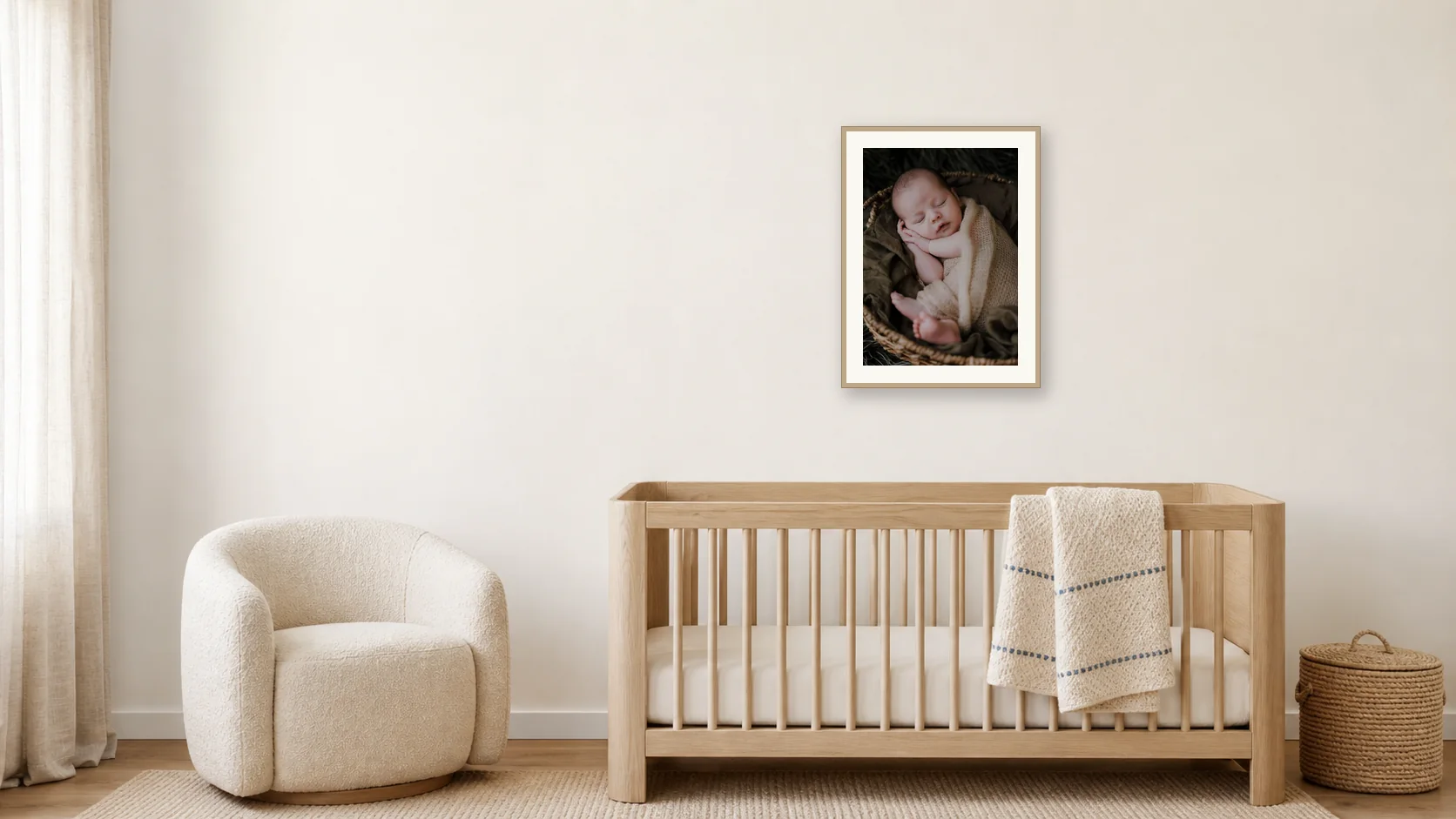
Paper matters more than people expect
The image can be stable while the thing underneath it yellows. That is what has happened to most old prints that look brown.
Cotton rag is made from cotton fibre with no lignin and no acid, usually buffered with calcium carbonate to neutralise pollution absorbed from the air. It has a slight texture and a soft, deep look. It does not yellow. This is what fine-art printing means when the term is used honestly.
Alpha-cellulose papers are wood pulp processed to remove lignin. Cheaper than rag, nearly as stable, and perfectly sensible for most work.
Resin-coated paper — RC — is paper sandwiched between two layers of polyethylene. It is what almost all standard photo prints are made on. It is tough, waterproof-ish and cheap, and it is fine for decades. Its weakness is the plastic itself: over long periods the coating can craze or separate, particularly if it has been through heat cycles.
Ordinary poster paper and untreated wood-pulp stock contain lignin, which oxidises and turns yellow-brown. That is the newspaper effect, and it has nothing to do with the ink at all.
Glass is the part everyone skips
Framing is more than presentation. The glazing is a filter sitting between the sun and your photograph, and the difference between the options is large.
| Glazing | UV blocked | Notes |
|---|---|---|
| Standard float glass | ~45% | Cheapest. Reflective. Some protection, mostly incidental. |
| Standard acrylic | ~60% | Light, shatter-resistant. Scratches easily. |
| UV-filtering acrylic | ~98% | Our usual choice for large pieces and anywhere near a window. |
| Conservation / museum glass | ~99% | Best protection, and the anti-reflective versions are close to invisible. Expensive. |
| No glazing (canvas) | 0% | Relies entirely on the ink and a protective coating. |
Upgrading the glazing on a big portrait typically adds a couple of hundred dollars in Sydney. On a piece you intend to keep for forty years in a bright room, that is the best money in the whole order.
Canvas has no glass at all, so its protection comes from a sprayed or rolled UV varnish. A good laminate on a pigment-printed canvas is genuinely durable. An unvarnished canvas is not, and it also collects dust in the weave, which cannot be wiped off easily. If you are weighing canvas against a framed print for other reasons, we have set those out in our comparison of the three formats.
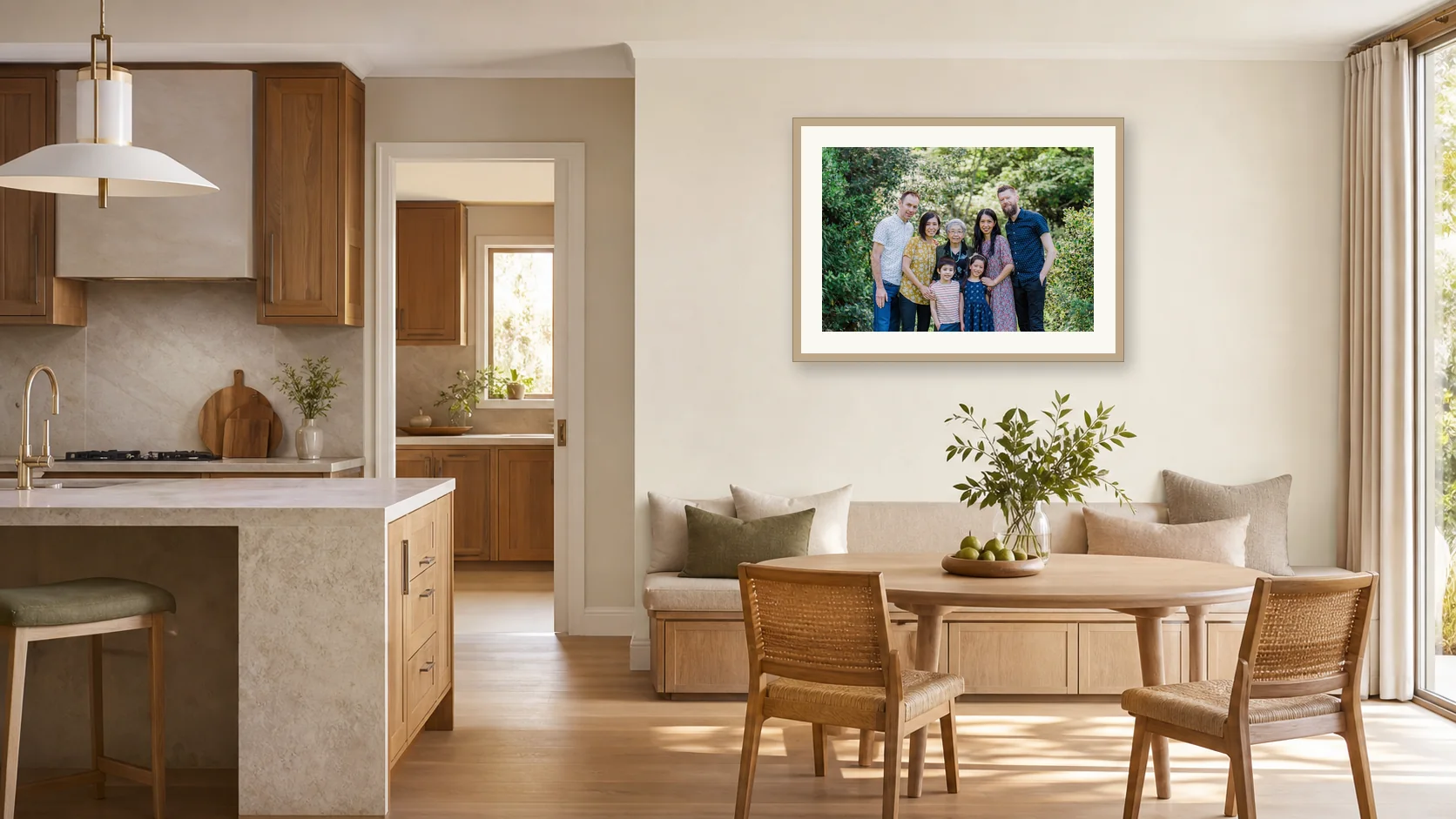
Sydney sun is harsher than the numbers suggest
Here is the honest advice, and it undercuts everything above: do not hang any photograph in direct sunlight, no matter how it is printed.
Australia gets substantially more UV at ground level than northern Europe or most of North America, because of latitude, clear air and a thinner ozone layer over this part of the world. The archival test figures you read online were generally produced overseas under standard indoor conditions. A western-facing Epping living room in January is not standard indoor conditions.
Direct sun also brings heat, and heat accelerates every chemical process involved in fading, including the yellowing of adhesives and mount board.
So: check the room at 4pm in summer, not at 10am in June. If a patch of sun crosses the wall at any point in the year, put the portrait somewhere else. There is almost always a wall at right angles to the window that gets bright indirect light and no direct beam, and that is the best spot in the house for a picture. We go through the rest of the placement decisions in our guide to choosing the right wall for a portrait.
What else quietly damages a print
- Acidic mount board. A cheap mat will burn a brown line into the print exactly where it overlaps, within about ten years. Ask for acid-free or museum board — it costs very little more.
- Humidity swings. Bathrooms and unairconditioned laundries cause paper to expand and contract until it ripples. Enclosed sunrooms are worse than people assume.
- Print touching the glass. Without a mat or spacer, condensation can bond the emulsion to the glass permanently. That is unfixable.
- Cooking residue. A fine oily film settles on everything in an open-plan kitchen, and it holds dust against the surface.
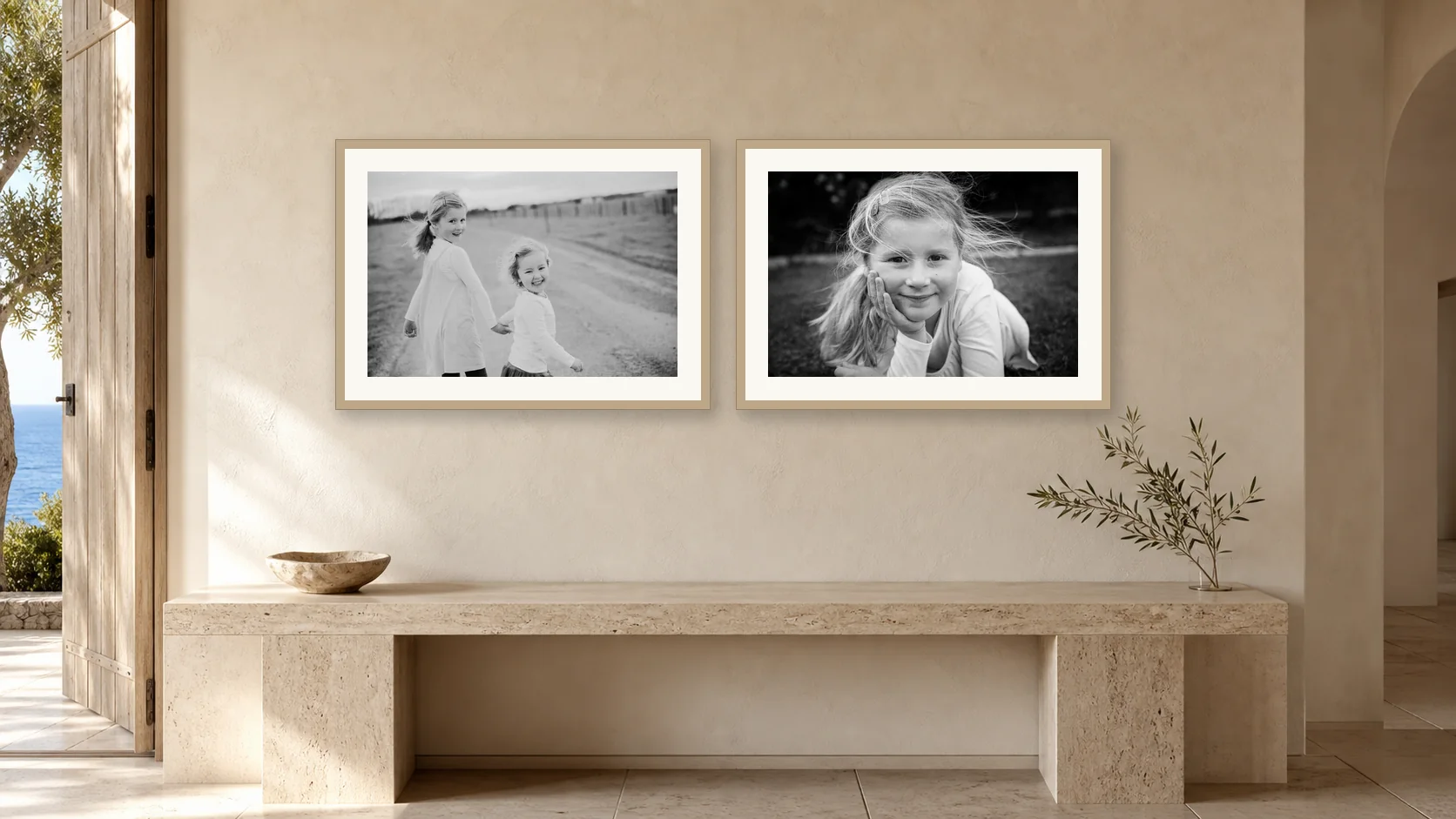
How do I check a print I already own?
You do not need a lab. Three quick checks tell you most of what you need to know about prints already on your walls or in a drawer.
- Look at the back. A pencil or stamp mark naming the paper or ink is a good sign. A bare white back with nothing on it tells you little.
- Compare the edge with the middle. If the print has been behind a mat, lift a corner gently and compare the covered strip with the exposed image. A clear difference in the reds and skin tones means light has been working on it for a while.
- Look at the white border and the mat. A brown line where mat meets print points to acidic board, not sunlight. That is a different problem with a different fix.
If you find a visible shift, take a phone photo now and keep it. It is a record of where the print stands, and it makes next year’s check meaningful.
A walk around the house, room by room
Fading is mostly a question of where a print hangs. Here is how we would think about the usual rooms in a northern Sydney house.
The hallway
Often the best place in the house. Light is indirect, temperature is steady, and nobody is cooking. A long hallway also gives you distance to view a larger piece.
The living room
Check which way the windows face. A wall opposite a west window will catch sun on summer afternoons, even if it looks shaded at lunch. A wall at right angles to the window usually gets bright light without the direct beam.
The open-plan kitchen and dining area
Fine for a framed, glazed print if it is away from the cooktop. Cooking leaves a fine film that settles on glass and is easy to wipe off. It is harder to remove from an unframed or canvas surface.
The bedroom
Good for quiet, personal pieces. Blinds are usually drawn for part of the day, which helps a great deal.
The bathroom, laundry and sunroom
We would avoid all three for anything you care about. Moisture and heat are the problem, and they act on the paper and the mount as much as on the ink.
What to do if the only good wall gets sun
Sometimes the wall you want is the wall the sun reaches. You have options before giving up on it.
- Blinds or sheer curtains for the hours the sun is on the wall. A sheer layer cuts the light a long way without closing the room off.
- Window film that filters UV. It is applied to the glass, protects everything in the room, and lets the view through.
- Better glazing on the frame, as discussed above, accepting that glazing slows fading and does not stop it.
- Rotating pieces if you own a few. Swapping two prints between a bright wall and a dim one every season spreads the exposure.
None of these makes direct sun safe. They make a marginal wall acceptable.
Your care checklist
Print this and tape it inside a wardrobe door. It covers the things that go wrong quietly.
- Walk the room at about 4pm in summer and look for any beam of sun on the wall.
- Keep frames a hand’s width away from air conditioner vents and heaters.
- Dust glass with a dry microfibre cloth. Spray the cloth, never the glass, if you need to dampen it.
- Leave a small gap between the frame and the wall so air can move behind it.
- Check every spare print stored in a drawer sits flat, interleaved with acid-free paper.
- Keep one high-resolution digital copy of each print somewhere other than your phone.
- Photograph your favourite prints once a year, in the same spot and light, to spot slow change.
A note on spare prints
Most families keep a few extras in a drawer. Storage is where good prints most often get damaged, so a little care pays off. Lay them flat, not rolled, and separate them from each other with acid-free tissue. Keep them in a cupboard inside the house rather than the garage, where heat swings through the year. A box under a bed in a conditioned room is better than a shelf in a shed.
If you have one print that matters more than the rest, the wedding-day portrait of grandparents or the only photograph of a person who has gone, treat the file as the real object and the print as a copy you can replace. That thinking is what lets you hang it on the wall in the first place, where you will see it every day.
Common questions
How do I know if a lab uses pigment ink?
Ask, directly: which printer and which paper. A lab doing archival work will answer instantly with a model name — an Epson or Canon large-format machine — and a named paper stock. Vagueness, or “all our prints are premium quality”, tells you what you need to know.
Do black and white prints last longer?
Usually yes. A monochrome pigment print uses black and grey inks, which are carbon-based and the most stable pigments there are. Colour prints fade unevenly because the different colour channels degrade at different rates, which is why old photos go magenta or cyan rather than simply pale.
Can a faded print be restored?
The original cannot be un-faded, but it can be scanned at high resolution and corrected digitally, then reprinted properly. Results on moderately faded prints are very good. Where a colour channel has gone completely, the correction becomes an interpretation rather than a recovery, and it starts to look painted.
Does a canvas last as long as a framed print?
A pigment-printed canvas with a proper UV laminate is respectable — think decades rather than a century. It is more exposed than a framed print because there is no glass, and its surface can be physically damaged by knocks and cleaning. It also cannot be re-mounted the way a print can be re-framed.
Should I still keep the digital file?
Absolutely. Prints and files protect against completely different risks, and the file is what lets you reprint in thirty years if a piece is damaged or you want a second copy for another child. We have made the broader case for doing both in why print your photos at all.
What to ask for when you order
Four questions, and any competent studio or lab should answer all of them without hesitating: pigment or dye, what paper, what glazing, and is the mount board acid-free. That is the entire specification. Everything else is presentation.
Our own prints are made on pigment printers on cotton rag, framed with UV-filtering glazing and acid-free board, because the whole point of photographing a family is that the picture outlives the afternoon it was taken on. If you want to see the difference between rag and standard photo paper before you choose, ask when you come in to Epping — we keep the same image printed both ways for exactly that conversation.
Wall art, finished by hand
Solid timber frames, cotton mat board and portraits sized for the wall they will hang on.