
Short answer: A framed print holds the most detail and suits faces. Canvas suits large, textural, softer images and rooms where glare is a problem. An album is the only one of the three that tells a story in order. Most families want one framed piece and one album, not three of everything.
These three things are not competing versions of the same product. They do different jobs, and the reason people agonise over the choice is that nobody explains what each one is for.
What a framed print is good at
Detail, and faces.
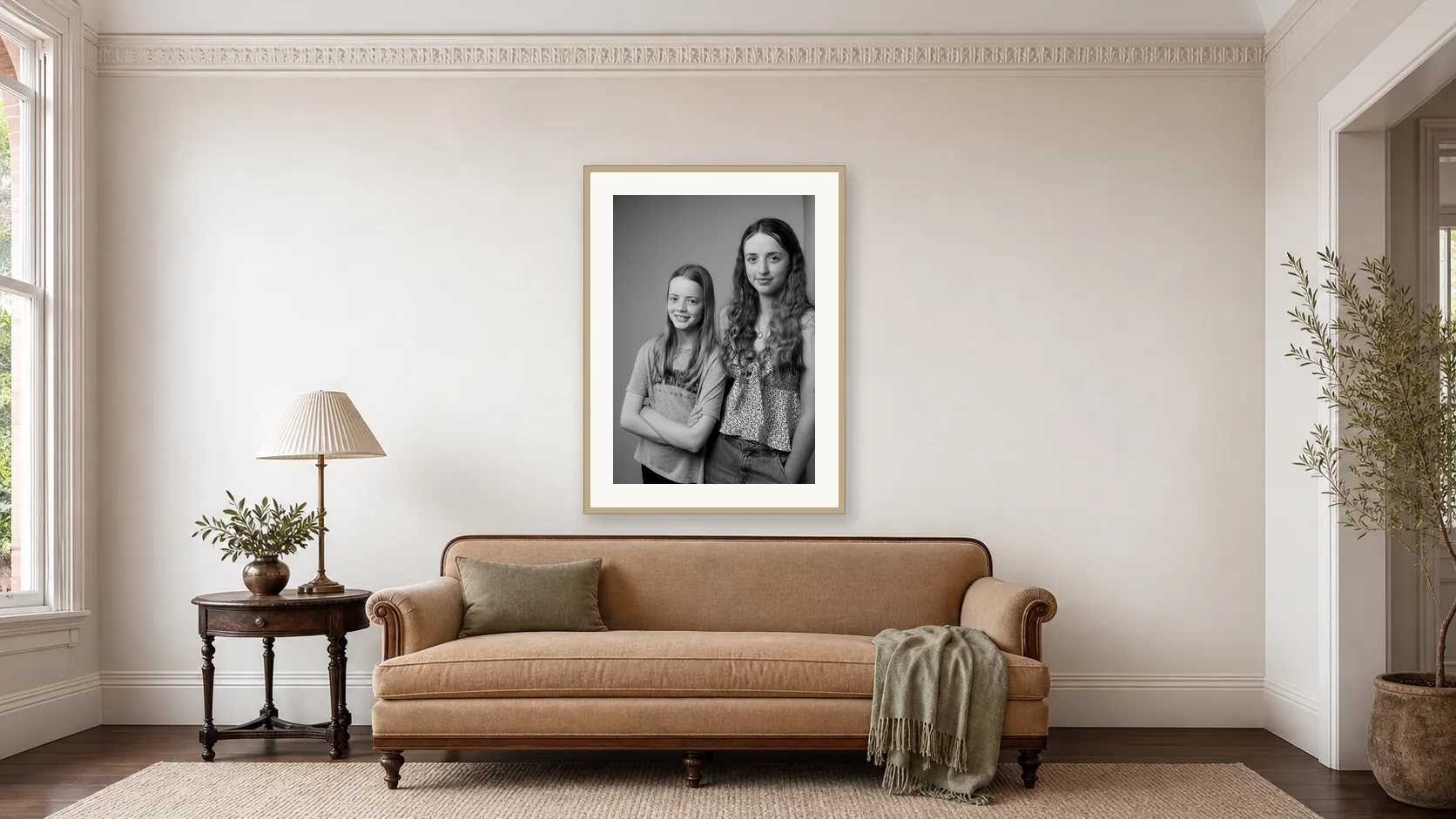
A photographic print behind glass keeps the fine structure of a picture — the individual eyelashes on a newborn, the texture of a knitted jumper, the catchlight in an eye. Stand 40cm away and it holds up. That matters for portraits more than for anything else, because a face is the one subject where people do lean in.
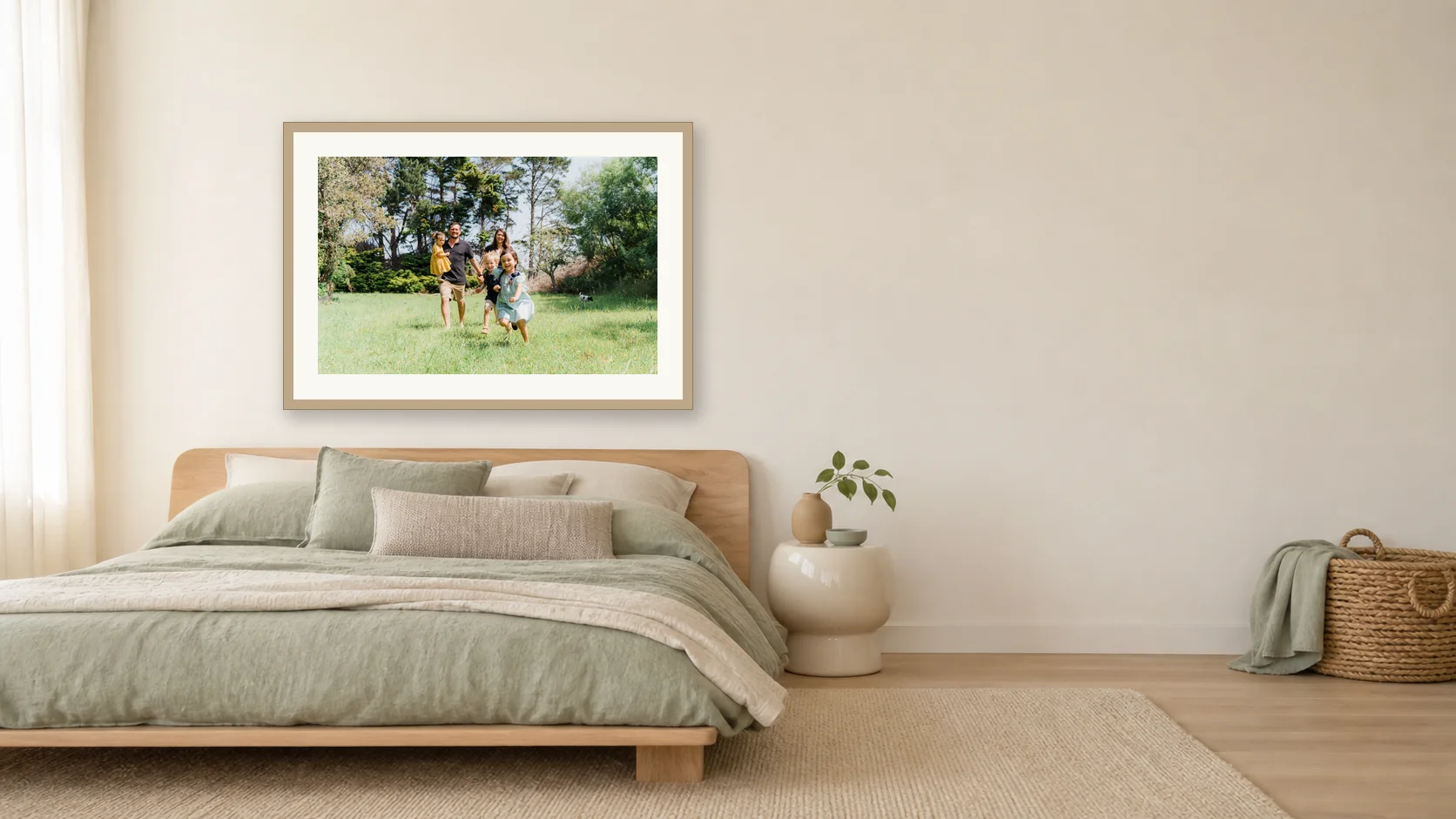
Framing also gives the image an edge and a border, which sounds trivial and is not. The mat and frame separate the photograph from the wall colour and tell your eye where the picture ends. It is the reason a framed piece reads as considered while an unframed one often reads as temporary.
The trade-offs are honest ones. Glass reflects, so a framed piece opposite a window can become a mirror at certain times of day. It is heavier, so it needs a proper hook. And it costs more than canvas at the same size, because there is more in it.
What canvas is good at — and where it has had its day
We will be straight about canvas, because there is a lot of nonsense talked about it in both directions.
Canvas has a woven surface. That weave sits on top of your photograph, and at normal viewing distance it eats fine detail. On a baby’s face, that is a real loss — the softness people describe as “painterly” is, up close, just detail that is no longer there. For a tight portrait we would rarely recommend it.
The gallery-wrapped canvas boom of roughly 2008 to 2015 is also genuinely over as a style. A 60×40 wrapped canvas of a beach family photo now dates a room the way a particular kitchen splashback does. That is a taste judgement, not a fact, and you are allowed to disagree.
But canvas remains genuinely good at three things, and we still sell it for them:
- No glare. It has no glass, so it works on a wall facing a big western window where a framed piece would be unviewable at 5pm.
- Large and light. A 150cm canvas weighs a fraction of the same piece framed behind glass, which matters on plasterboard and in rentals.
- Softer, wider images. Landscape-style family shots, back-lit outdoor sessions, black and white with lots of grain — pictures where texture is part of the look rather than a loss.
Somewhere in the middle sits the framed canvas, which is a canvas set into a floating timber frame with no glass. It keeps the no-glare advantage and gets back the finished edge. It is our usual compromise when a room has a light problem.
What an album does that neither wall piece can
Sequence.
A wall print is one frozen moment. An album is forty of them in an order somebody chose, and the order is where the meaning is — the baby asleep, then the older brother’s hand, then the mother’s face watching. You cannot hang that. You have to turn pages.
Albums also solve the problem of the other thirty good photos. Every session produces images worth keeping that will never be big enough or bold enough for a wall. In a drawer as loose prints they get bent and lost. In a bound book they get read.
The physical difference between a cheap photobook and a proper album is worth knowing. A supermarket-style photobook is printed on paper stock and glued at the spine, which means it will not lie flat and the gutter swallows the middle of every double-page image. A fine-art album is printed on thick board pages and lay-flat bound, so a single photo can run across the whole spread without a seam eating the face in the centre. It costs several times more and lasts several times longer.
Side by side
| Framed print | Canvas | Album | |
|---|---|---|---|
| Best for | Faces, fine detail, formal portraits | Large soft images, glary rooms | A whole session, in order |
| Detail held | Highest | Reduced by the weave | High, at small size |
| Glare | Yes, unless non-reflective glass | None | Not applicable |
| Weight at 100cm | Heavy | Light | Not applicable |
| Seen daily? | Yes | Yes | Only when opened |
| Weak point | Reflections, cost | Texture over faces, dated look | Lives in a cupboard |
| Sydney market range | $400–$2,500 framed | $250–$900 | $600–$3,000 |
Those price bands are what Sydney portrait studios generally charge, not our prices. What moves a piece from one end to the other is size, whether the framing is machine-made or hand-finished, whether the glass is standard or museum-grade, and in albums, the number of spreads and the cover material.
What we usually suggest
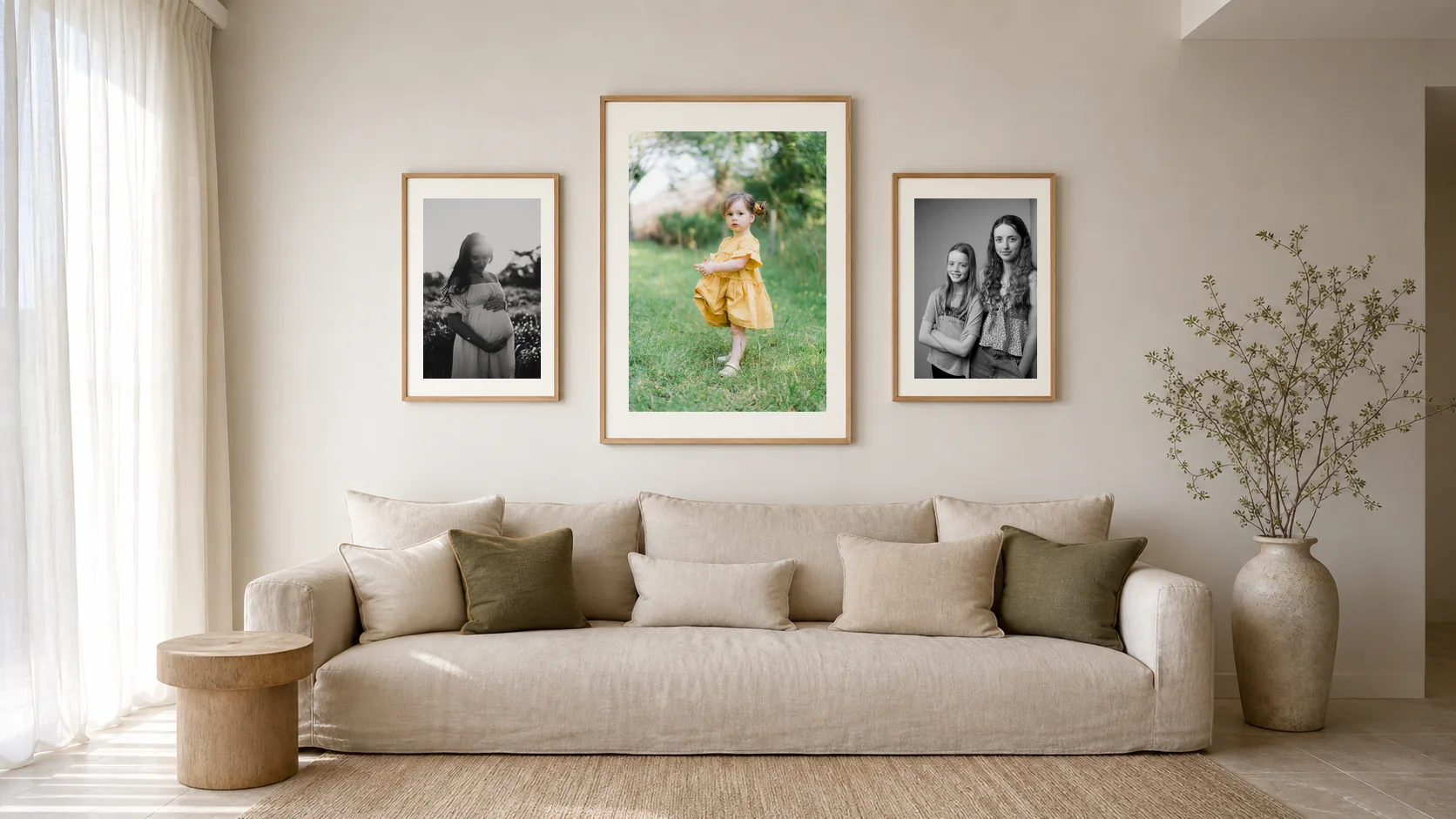
One wall piece and one album. That combination covers both jobs — the photograph you see without choosing to, and the story you sit down with.
If the budget only reaches one of them, choose by household. Families with older kids and a proper living room wall get more out of the wall piece. Families with a newborn get more out of the album, because a newborn session has a narrative and because the wall piece is often better made a year later when the face has settled.
Whatever you pick, size it against the room rather than the price list — the most common regret is a lovely piece that is too small for where it hangs, which we set out properly in our wall art size guide.
How do I decide which one fits my room and my family?
The right choice often comes down to one wall and one question about how you live. Work through these.
- If the wall faces a large window, check the glare at the time of day you are home. A framed piece with standard glass can turn into a mirror, so consider non-reflective glass, a framed canvas, or a different wall.
- If you rent and cannot drill, weight matters. Large framed pieces need solid fixings, and canvas is lighter. Ask about lighter framing options before you decide.
- If the room has small children, think about height and sticky hands. A piece above a sideboard is safer than one on a low hallway wall, and an album lives better on a shelf than a coffee table.
- If the picture is a close portrait, choose the surface that holds the most detail. If it is a wide, soft outdoor image, there is more room to choose texture.
- If you want to give it as a gift, an album travels and posts easily. A large framed print is awkward to transport and best delivered rather than carried.
What should I look at in person before I order?
A screen shows colour and sharpness but hides almost everything that matters about a printed object. If you can visit a studio or a lab, look at these things yourself.
The edge. On a framed piece, look at how the mat, glass and frame meet. Gaps and dust inside the glass are easy to see up close. On a canvas, check the corners and the depth of the sides. On an album, look at how the cover joins the pages.
The surface in raking light. Hold the piece at a shallow angle to a window. Reflections, the canvas weave and any ripples or cockles in the paper show up straight away.
The skin tones. Look at faces first. A print can be sharp and still have faces that look too warm, too green or too flat. Skin is the colour your eye notices before any other.
The spine of the album. Open it flat on a table. A well-made lay-flat album opens without a dark gutter swallowing the middle of each spread. If the middle of a double-page image is lost, you will see it in every picture you choose.
The weight in your hands. Pick it up. A piece that feels flimsy is usually flimsy to live with, and a very heavy one needs a proper wall fixing rather than a nail.
How do I plan a first order without overbuying?
The cleanest approach is staged. Pick the single best photograph from the session, choose the surface that suits it, and order that first. Live with it for a few weeks. Then decide whether you want an album or a companion piece.
- Measure the wall and the furniture beneath it, and write both down.
- Note which way the nearest window faces and when you are home.
- Choose one hero image and one supporting set for an album.
- Ask to see a print of the same type before you commit.
- Ask what glass or coating options exist, and what each changes.
- Confirm how the piece will be hung or fixed, and who supplies the fixings.
- Ask how long the studio keeps your files in case you reorder.
Resist the urge to buy the album, the wall piece and the canvas in the same week. It is easy to choose pictures for the first and run out of good ones for the others, and a second order placed a month later is almost always better judged.
If you are still undecided, cut a piece of paper to the size of the print, stick it to the wall with low-tack tape for a week, and walk past it. If you stop noticing it, go larger or move it. If it irritates you, you have learned something cheaply, and the album is probably the better fit.
Common questions
Is canvas cheaper because it is lower quality?
It is cheaper because there is no glass, no mat, no framing labour and less material. A good canvas is a good product. It is simply a different surface, and that surface suits some pictures and actively harms others. Price is not the thing to judge it by.
Can I get a print without glass but not on canvas?
Yes — a photographic print face-mounted to acrylic, or bonded to aluminium composite. Both give you a hard, glare-controlled surface with the full detail of a print. They read as modern and slightly commercial, which suits some homes and fights with others. Ask to see one before deciding.
How many photos should go in an album?
Between 25 and 50 images across 15 to 25 spreads is the range where an album still has pace. Past that it becomes a catalogue and people stop turning pages halfway. Fewer, well sequenced, is almost always better.
Will the album damage from being handled?
A lay-flat album with board pages is built to be handled and will survive children turning the pages, which is the point of owning one. Keep it off a sunny windowsill and out of a bathroom. Beyond that, use it.
Do any of these last longer than the others?
Yes, and it depends on inks, paper and glazing rather than on the format itself — a well-made canvas can outlast a badly made framed print. We go through the materials that actually matter in our piece on archival printing.
Choose the object for the job, then the photo for the object
The mistake is picking the favourite image first and then wondering what to do with it. Work the other way. Decide whether you need something on the wall, something to read, or both; decide where in the house it goes; then choose the picture that suits that surface at that size.
We keep all three on the walls and the table at the studio in Epping for exactly this reason — a backlit screen hides the one thing that decides this, which is how each surface handles the light in your room. Come and hold the album and look at the same face printed two ways. You will know within a minute which one is yours.
Wall art, finished by hand
Solid timber frames, cotton mat board and portraits sized for the wall they will hang on.