Short answer: Book the session for 30 to 45 minutes after your baby normally wakes from a sleep, and feed them right before you walk in. A fed, rested baby under one gives you about 40 good minutes. Light, outfits and locations all matter less than hitting that window.
Parents ring us asking about golden hour. Then they arrive at 5pm with a nine-month-old who last slept at 1pm, and no light in Sydney is going to fix that.
The nap beats the light, every time
A baby under one has a short, non-negotiable window of good humour. It opens when they wake up fed, and it closes somewhere between 40 and 70 minutes later. Nothing you do extends it much.
Our studio is lit, which means we can make 10am look exactly like 4pm. So we would rather you pick the slot that suits the sleep schedule and let us handle the rest. If you are shooting outdoors, you have a genuine conflict — and even then, we would still choose the baby’s window and accept slightly harsher light.
Picking a time by age
Babies under one are not one group. A four-month-old and an eleven-month-old are on completely different timetables.
| Age | Best slot | What you are working around |
|---|---|---|
| 3–5 months | Mid-morning, after the first nap | Sleep is still scattered; the morning wake is the most reliable point |
| 6–8 months | Late morning, around 9.30–10.30am | Two naps a day. The gap after the first one is the long, cheerful stretch |
| 9–11 months | Late morning or 3–3.30pm | Dropping to one nap. Ask us for whichever side of it your baby prefers |
| Around 12 months | Late morning, and keep it short | Newly walking, and far more interested in the floor than in you |
Tell us the wake times when you book. We would rather move a booking to 9.45am than have you arrive at a neat hour with an overtired baby.
Feed them in the car park, not at home
A feed at home followed by a 25-minute drive from Ryde or Hornsby means the baby is hungry again by the time we start. Feed on arrival instead — there is a chair and nobody is watching the clock. Ten minutes of feeding before we start buys us thirty minutes of contentment afterwards, which is the best trade available on the day.
Bring the next feed too, whatever form that takes. A session that goes long goes long because the baby is delightful and we do not want to stop.
Dress the baby last
Nappy blowouts happen at the worst possible moment and they happen most often in the car. Travel in something plain and easy, and change the baby into the good outfit once you are here. Same for anything with buttons up the back.
Two outfits is the right number. More than that and you spend the good window doing wardrobe changes instead of photography. Skip anything with a stiff waistband — a baby that cannot sit comfortably will not sit for long.
What the photos actually look like at this age
Under one, the best frames are almost always contact frames: the baby held against a shoulder, on a parent’s lap facing in, on a hip mid-laugh. Not a baby propped alone in the centre of a group, which is the shot parents imagine and rarely the one they choose afterwards.
If your baby has just started sitting unaided, tell us — there is a very short period around six to eight months where they can sit but not crawl away, and it is the easiest they will be to photograph until they are about four. We wrote about that window in our guide to sitter sessions.
Older siblings change the plan
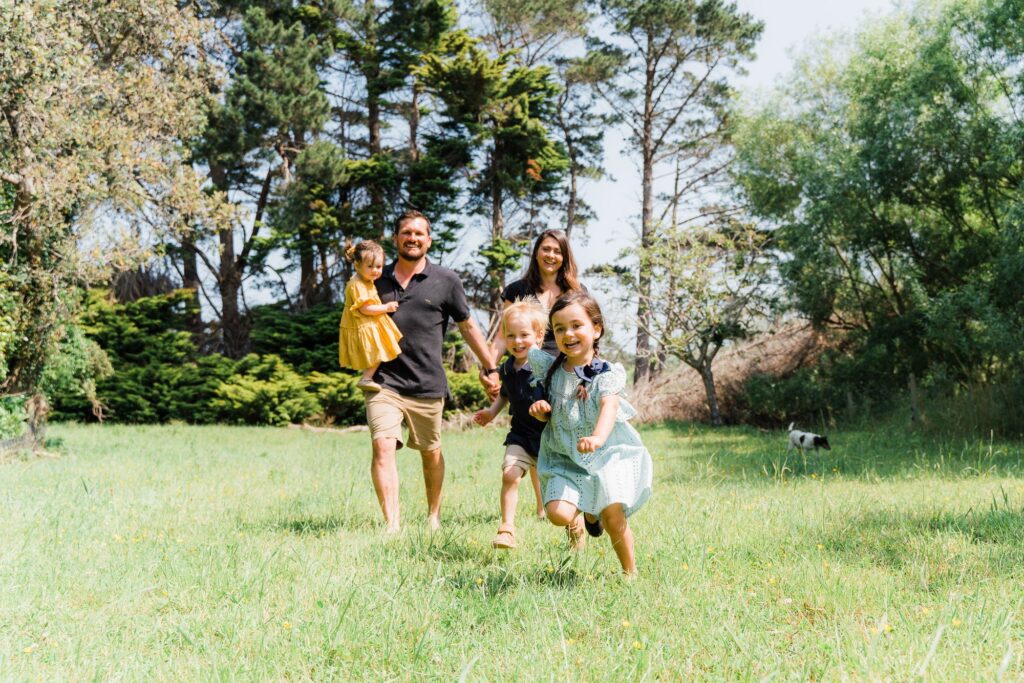
If the baby has a big brother or sister, the sibling frames get taken early, while the baby is at their best and before the older one has decided this is boring. We do the group shot second and the individual portraits of the older child last, because a four-year-old can be brought back around with a bit of negotiation and a baby cannot.
If your older child is at the stage where they run the household, our piece on surviving family photos with toddlers is worth ten minutes before the day.
What to bring
- A feed, plus a spare
- The dummy, if it is used — we can take it out of frame in a second
- One familiar toy that makes a noise, and nothing that lights up
- Two changes of clothes and a spare nappy more than you think you need
- Muslin wraps, because babies drool on shoulders and shoulders are in shot
- A hairbrush for you, because you will have carried a baby in from the car
What does a good session timeline look like for a baby under one?
Take a seven-month-old called Theo from Eastwood. He wakes at 7am, naps from 9.15 and is up again by 10.30. A good booking starts at 11am. The family arrives at 10.50, which gives ten minutes to settle in and no one has to rush from the car.
The first twenty minutes are for the frames that need Theo cheerful and awake: the parents together with him, then him with each parent alone. Those are the images that get framed. The middle stretch is looser, with a cuddle on the floor, a small toy, a laugh when someone pulls a face. If a feed is needed, it happens here, without a fuss. The last stretch is short and soft, usually Theo drowsy against a shoulder.
Set against that, a family who arrives at 1pm with a baby who has not slept since breakfast is doing well just to get through the door. The plan is the same, but the window is far smaller.
The principle is to put the important frames early and let the end be an afterthought. Babies give you their best at the start and their most honest at the end, and the gap between those two is the part to plan around.
Which baby cues should you watch for, and what do you do?
| What you see | What it usually means | What helps |
|---|---|---|
| Rubbing eyes, pulling ears | Tired | A short pause in a quiet corner, or a cuddle and a cover over the pram |
| Turning the head away from the bottle or breast | Distracted or finished | Burp, wait, offer again a little later |
| Arching the back, grizzling | Hungry, wind or overstimulated | Change the room: dim the voices, walk, feed |
| Staring at one spot | Overloaded | Everyone steps back and stops talking for a minute |
| Big smile, kicking legs | Peak mood | Take the frames now, quickly |
You know your baby’s signals better than we do. Say so out loud during the session. “That is her tired noise” lets us stop shooting before things unravel, and a pause of five minutes often saves twenty.
What should the grown-ups do to help?
Parents are the best prop in the room, so a few habits matter.
- Be the one the baby looks at. Stand next to the camera, not behind it, and talk. A baby’s eyes follow the voice they know best.
- Hold properly, not carefully. A nervous, stiff hold makes a baby wriggle. Settle them into your arm the way you do at home.
- Do not hover. If you step in to wipe a nose every thirty seconds, the baby never relaxes. Tell us which things need cleaning and we will pause for them.
- Let grandparents wait for their moment. A queue of loving relatives, all trying to make the baby laugh, is a quick way to overwhelm them.
- Stay quiet about the clock. Babies pick up on stress faster than any camera does.
If a sibling is coming, give them a job. Holding the spare muslin, choosing which toy the baby gets next, or being the one who makes the silly noise. A child with a role is calmer than one told to be good.
A calm-morning checklist
- Tell us wake times, nap lengths and feed times when you book.
- Travel in a plain, comfortable outfit and change on arrival.
- Pack two feeds, the dummy and a clean muslin.
- Leave early enough to park in Epping without hurrying.
- Bring a second adult if there is an older child.
- Agree who will hold the baby in which frame before you start.
- Decide in advance that a break of ten minutes is perfectly acceptable.
Last, keep the day around the session gentle. No extra errands before, no visitors the night before, and a plan for a cuddle and a rest afterwards. A baby who has had a quiet morning is a baby who looks at the camera like they have all the time in the world.
The images of a baby under one are usually small. A hand holding a finger, a foot, the weight of a head on a shoulder. Mention to us which of those details you would most like, and we will make sure the session leaves room for it.
Common questions
What if the baby cries the whole time?
Then we stop and you feed or settle them, and we wait. It happens in maybe one session in six and it has never ended a shoot. Crying babies are a delay, not a failure. We build the slack into the booking, so nobody is being rushed while you walk a grizzly seven-month-old around the room.
Is it too late for newborn-style photos?
Curled, sleepy newborn poses stop working from about four weeks, so at three months that ship has sailed. What you get instead is better in its own way — eye contact, real expressions and genuine interaction with you. Different pictures, not lesser ones.
Can we come on a weekend?
Yes, and weekends fill first. The catch is that weekend mornings often collide with the nap that actually works for your baby. If the good slot is a Tuesday at 10am and one of you can take the morning off, that session will go better than the Saturday one.
Should we reschedule if the baby is teething?
Teething alone, no — most babies are fine for an hour with a cold teether in the bag. A temperature, a cold or a bad night, yes. Ring us. Moving a booking costs nothing compared with photographing a miserable baby and wishing you had waited a fortnight.
Do both parents need to be in the photos?
Both should be. The most common regret we hear is from mothers who spent every session holding the camera or standing off to the side, and have almost no photographs of themselves with their baby. You are part of the picture. Get in it.
Pick the time first, then everything else
When you email us, do not lead with a preferred date. Lead with the sleep. Tell us when your baby wakes, when they usually go down, and how long the drive is from your place — Epping, Eastwood and Ryde are close enough that the nap survives the trip, and further out we will plan around the car.
We will find the slot that sits in the good window, and the photographs will look after themselves. Send the wake times to info@tzportraits.com and we will come back with two or three times that fit.
Family portraits that belong on the wall
Relaxed, unhurried sessions, photographed, printed and framed for the wall you walk past every day.