Short answer: A three-generation family photo works best on a weekend late morning, in a studio, with 90 minutes booked and the oldest and youngest photographed first. Twelve people in one room needs one organiser, one confirmed date and a plan for who stands where before anyone arrives.
The hardest part of a three-generation portrait is not the photography. It is getting everybody in the same postcode on the same Saturday. We have had families take four months to land a date, then shoot the whole thing in an hour and a quarter.
Why families book these sessions
Some of them are happy occasions. A grandparent turns 80. A sibling is home from Singapore for three weeks. A new baby arrives and suddenly there are four generations alive at once, which is rarer than people think.
And some of them are not. A fair number of the extended family sessions we photograph in Epping are booked because someone has had a diagnosis. Nobody says that on the enquiry form. It usually comes out in the studio, quietly, from a daughter while her mother is being seated.
We mention this because if that is your situation, you are not being morbid and you are not late. You are doing a sensible thing. Tell us when you book, in one sentence, and we will plan the order of shots around it. You will not be asked to explain again on the day.
Who actually organises it
One person. Not a group chat with eleven opinions in it.
Pick the family member who is best at nagging — usually the eldest daughter or the one who books the Christmas lunch — and give them the date, the address, the arrival time and the clothing note. Everyone else takes instructions from them. When two people co-ordinate an extended family shoot, someone always turns up in a black tee because they were told the wrong thing.
How long to allow for twelve people
We plan on roughly 90 minutes of studio time for ten to fourteen people. That sounds generous until you work out what is in it.
| Stage | Roughly | What happens |
|---|---|---|
| Arrival and settling | 15 min | Bags down, toilet trips, shoes checked, jackets off |
| Grandparents alone | 10 min | The shot that matters most, taken while they are fresh |
| Grandparents with grandchildren | 15 min | Kids are still co-operating at this point |
| Each small family unit | 20 min | Three or four quick groupings, rotated |
| The full group | 20 min | Hardest shot, needs everyone awake |
| Spares and swaps | 10 min | Couples, siblings, anything requested on the day |
Two hours of standing is too much for an 84-year-old and far too much for a two-year-old. If the group is over fifteen, we split the session across two arrival times rather than stretching one.
Photograph the oldest and the youngest first
This is the one rule we will not bend. Grandparents and small children both run on a limited battery, and it drains faster than anyone expects.
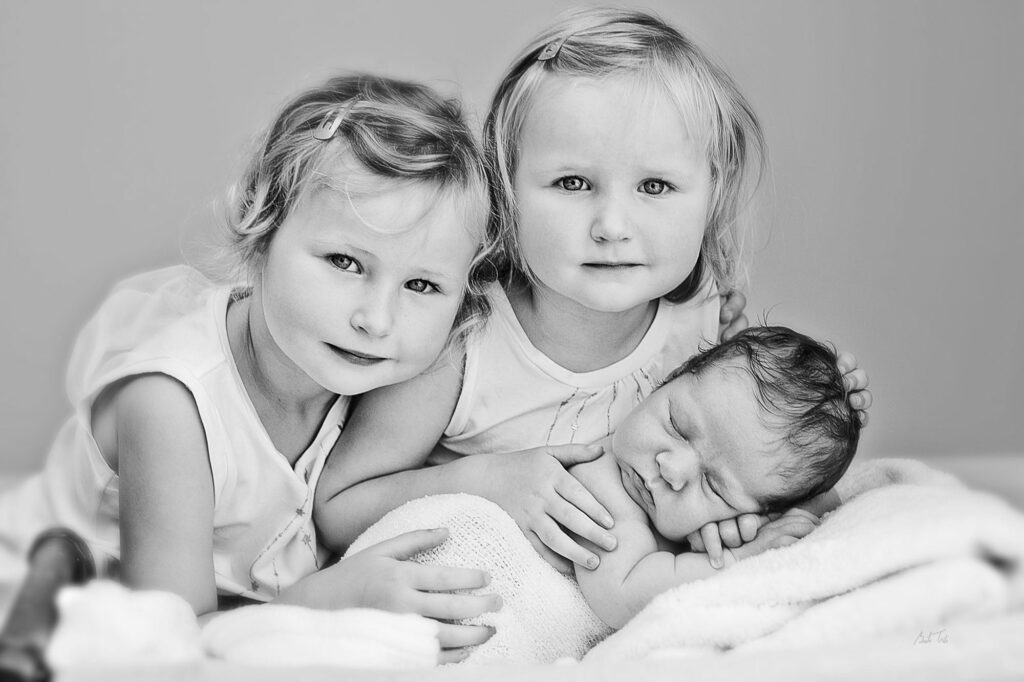
So the very first frame of the day, before the lighting has even been tweaked for the big group, is grandma and grandad. Then grandparents with the grandkids. Then the toddler, while she still thinks the studio is interesting rather than boring. The teenagers, the adult siblings and the full group can all wait — they will still look fine at minute 80.
Doing it the other way around is how you end up with a beautiful group shot and a tired, closed-off portrait of the person the whole thing was for.
Seating, not standing
Older relatives should be sitting for most of the session, and the composition should be built around them rather than the other way round. We use a bench or a low armless chair so the person can get in and out without help, which matters more to dignity than most photographers realise.
If someone uses a walking frame or a wheelchair, tell us beforehand. There is a version of every grouping that works with it, and there is a version that hides it entirely if the family would rather. Both are fine. It is your photo.
What everyone should wear
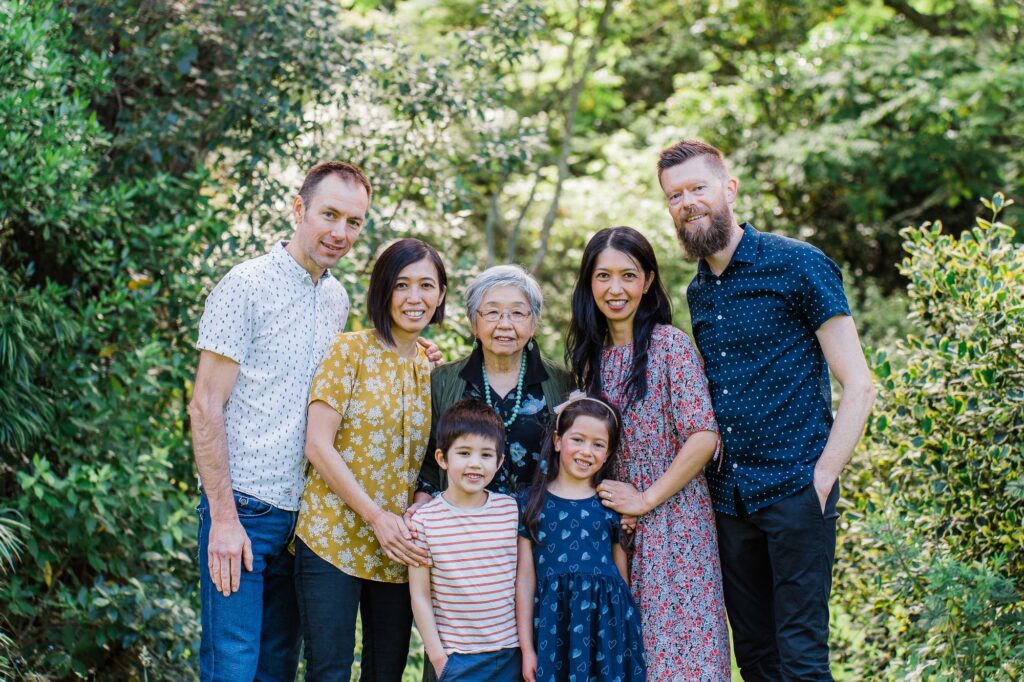
Twelve people cannot be colour-coordinated by committee. Pick one person — often the grandmother, since she is the anchor of the picture — and build outwards from whatever she is comfortable in. Two or three colours across the whole group is plenty. Long sleeves photograph better on older arms, and nobody has ever regretted avoiding a logo.
We go into this properly in our guide on what to wear for family photos in Sydney, and the same method scales up to a large group.
Studio or a park?
For extended family, we lean studio. A park adds wind, glare, a walk from the car park and no toilet, and with twelve people those small frictions multiply. The studio has climate control, chairs, and light that does not change at 4pm.
Outdoors is the better choice when the family has a real attachment to a place, or when the group is large enough that no indoor space holds it. If you are weighing it up, our comparison of studio versus outdoor family photos covers the trade honestly.
What do I do about the person who dislikes being photographed?
Every large family has one. It is often the oldest man, the teenage grandson, or the daughter who has lost confidence in how she looks. Pushing them rarely works, so plan around them.
Ask them privately what would make it easier. The answer is usually practical: a chair with arms, no bright lights in the eyes, not being the centre of the shot. Tell the photographer, and we will arrange it. You do not have to explain to the room.
Put them next to someone they love. A grandfather who stiffens in front of a lens often relaxes beside a grandchild who is wriggling on his knee, because the child needs his attention more than the camera does. A sulky seventeen-year-old does better beside a favourite aunt than beside a parent.
Give them a job in the frame. Holding a baby, steadying a toddler, or guiding a great-grandmother to a chair gives hands and eyes somewhere to go. The self-conscious expression is usually a bored one. Occupy the person and it softens.
How do we make sure everybody turns up in the right clothes, at the right time?
The organiser sends one message, not a stream of them. Keep it to the date, the arrival time (earlier than the booking, because someone is always late), the address, the clothing note and a contact number for the day.
Build in a buffer. If you want the group at the studio at ten, tell the older relatives nine forty-five and the teenagers nine thirty. People who dislike hurrying will be calmer, and the unavoidable lateness will cost you nothing.
Check transport for the oldest relatives. Who is collecting grandma? Is there a seat for her close to the door? Parking for someone with a frame is not the same as parking for a driver in a hurry. Confirm it two days before and again the evening before.
On the clothing, ask everyone to avoid heavy patterns and very bright logos, and to wear shoes they can stand in comfortably. There is more detail in what to wear for family photos in Sydney.
What if the family has several households, or tensions?
Three generations often means divorced parents, step-grandparents, new partners and children from different marriages. Photographers see this all the time and it does not shock us.
If you want everyone together, say so clearly to everyone before the day, and let the people involved decide what feels fine for them. If you would rather have separate groupings, ask for them. We can photograph grandparents with their own children and grandchildren in one set, and a different branch in another, and each one gets a good portrait.
Seat people so that nobody who struggles with someone else is next to them, and leave a little space in the group for the child who is caught in the middle. A calm studio morning does not need to resolve anything. It only needs to avoid creating a new problem.
Tell us the sensitive details when you book, in a line or two. Who needs to be separated, who is grieving, who is new to the family. We treat all of it as ordinary and we do not repeat it on the day.
A checklist for the organiser
- Confirm the headcount and the ages of the oldest and youngest
- Send one clear message with date, arrival time, address and clothing note
- Give older relatives an earlier arrival time than the booking
- Arrange a lift and a seat near the door for anyone who needs it
- Tell us about mobility needs, hearing issues or anything that affects seating
- Agree who looks after the toddlers in the gaps between shots
- Pack tissues, water, a snack and a hairbrush
- Decide in advance which one or two frames matter most
Before you leave the studio, ask one small thing of the whole group: a quiet minute with just the two oldest people and the youngest child, whatever the age gap. It costs almost nothing and the family will have one more photograph to cherish.
Common questions
How many people is too many for one session?
Around fifteen is where a single 90-minute booking stops working comfortably. Above that, the group shot itself is still straightforward — we just need more time for the smaller combinations, and more breaks for the older members. Tell us the headcount when you enquire and we will build the timing around it rather than squeezing you in.
What if a grandparent is unwell on the day?
Let us know as early as you can and we will move it. We would rather reschedule than photograph someone who is having a bad day, because you will see it in the face forever. If the illness is ongoing and waiting is not sensible, say so — we can shorten the session to 40 minutes and get the essential frames only.
Can we include family who live overseas?
Not convincingly in one frame, no. We do not composite absent relatives into group portraits — it never looks right and families tend to regret it. What works better is photographing the group as it is, and making a second, smaller portrait when the overseas family visit.
Should the grandchildren be in every shot?
No, and that is usually a relief to hear. The grandkids should be in the grandparent shots and the full group. For the rest, let them play at the side of the room. Forcing a four-year-old into eight consecutive setups is how you lose the last twenty minutes of the session.
When should we book?
Six to eight weeks ahead if you are co-ordinating flights, and Saturday mornings go first. If someone’s health is the reason for the session, ring us and say so — we hold a small amount of space for exactly that.
The one frame this is all for
When families come back to choose prints, the big group shot is almost never the one they enlarge. It is the quiet one: two grandparents, seated, looking at each other or at a grandchild on a lap. Everything else in the session exists to make that frame possible while they still had the energy for it.
So plan the day around that photograph. Get it in the first ten minutes, print it big, and hang it where the family walks past it. If you have a date in mind, email us at info@tzportraits.com with the headcount and the ages of the oldest and youngest, and we will send back a running order for the morning.
Family portraits that belong on the wall
Relaxed, unhurried sessions, photographed, printed and framed for the wall you walk past every day.