Short answer: Stop asking for a smile. Ask a question, give an instruction they can fail at, or make one specific joke — then photograph the two seconds after. Saying “cheese” produces a stretched mouth with dead eyes, because the word shapes the lips without involving the rest of the face.
Every parent in the room says it, usually in the same anxious voice, usually three times in a row. And every time, the child produces the one expression they have learned to produce on command: teeth bared, eyes flat, chin down. It is the worst face they own and they only ever use it for cameras.
Why “say cheese” fails, mechanically
A real smile involves the muscle around the eye. That muscle is not under voluntary control for most people, and it is certainly not triggered by pronouncing a vowel.
The word “cheese” pulls the corners of the mouth sideways and holds them there. Sideways is the wrong direction — a genuine smile lifts. So you get wide lips, no crinkle at the eyes, and a child who is now consciously performing rather than reacting. Hold it for four seconds and it curdles into a grimace.
Worse, it teaches the child that “photo” means “make the face”. By age six they have it locked in, and every subsequent photographer inherits the problem.
What we say instead
The job is to get a reaction, not a pose. These are things that actually come out of our mouths in the Epping studio, in rough order of how often we use them.
- “Whatever you do, do not laugh.” The oldest one in the book and it still works on anyone aged three to nine. Say it seriously. Wait.
- “Can you say the worst smelling thing you can think of?” The answer is usually a sibling, and the laugh comes from the parent first.
- “Tell me something true about your teacher.” Open questions beat yes-or-no questions. You get a real face while they think.
- “Dad, say your daughter’s name wrong.” Kids find parental incompetence hilarious. Use it.
- “Push your brother over. Gently.” Permission to misbehave, with a limit. Produces about four usable frames.
- “Blow me a raspberry as loudly as you can.” For two- and three-year-olds. The face right after is the one we keep.
- Nothing at all. Silence for five seconds while looking through the camera makes older kids fidget and then break. That break is the photograph.
Match the tactic to the age
| Age | What works | What backfires |
|---|---|---|
| 1–2 | Sounds, peekaboo, a toy that disappears | Anything requiring them to understand an instruction |
| 3–5 | Silly permission, wrong answers, a job to do | Being told to sit still and smile nicely |
| 6–9 | Jokes, challenges, “bet you can’t” | Baby talk — they notice and they resent it |
| 10–13 | Being spoken to like an adult, given some control | Anything that makes them self-conscious in front of siblings |
| Teenagers | Honest direction, and not asking for a smile at all | Enthusiasm. Meet them where they are |
Parents: the thing you are doing that is not helping
Standing behind the photographer, waving, and saying the child’s name in a strained voice. We know it comes from wanting the session to go well. It does the opposite — the child looks past the lens at you, the eyeline goes wrong, and they can hear that you are stressed.
Two other habits worth breaking on the day. Do not threaten (“no iPad if you don’t smile”) — it produces exactly the tight face you are trying to avoid. And do not apologise for your child in front of them. A four-year-old who hears “sorry, she’s being difficult” becomes considerably more difficult.
The most useful thing a parent can do is laugh genuinely at something. Kids mirror their parents faster than they respond to a stranger with a camera.
Bribery, done properly
It works. It just has to be structured, or you end up negotiating with a five-year-old for forty minutes.
The rules we use: name the reward before the session starts, make it small, and give it at the end, not in instalments. A milkshake afterwards is ideal. Lollies handed out mid-session are not — you get sticky hands, blue tongues and a child who has learnt that stalling produces more lollies.
Never make the reward conditional on smiling. Make it conditional on staying, which is a thing a child can actually control. There is more on this in our toddler survival guide.
Not every good photo has teeth in it
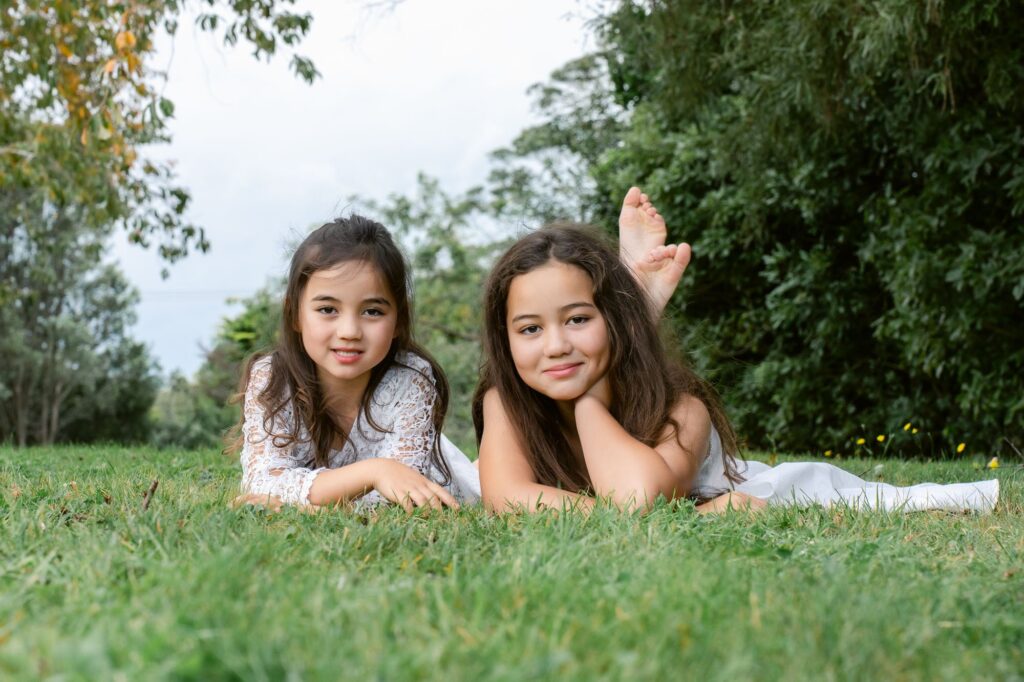
This is the part parents find hardest to accept. When a family comes in to choose prints, the frame they enlarge is very often not a big grin. It is the child looking straight down the lens, calm, a bit serious, completely themselves.
Small children in particular have a natural resting face that is far more interesting than their performed smile. A quiet portrait of a six-year-old who looks like a real person will outlive a room full of gap-toothed beams. We will take both, but do not panic when we spend a few minutes on the serious one.
What should a parent actually do during the session?
Most parents want a job. Standing still while someone else works with your child feels wrong. So here are three jobs that help.
- Be the audience. Stand beside the camera, not behind the child. If you laugh at something we say, the child looks towards the laugh, and that eyeline is usually the one we want.
- Carry the small stuff. Water, a tissue, a spare top. Pass them over quietly and say nothing.
- Stay out of the commentary. If your child is struggling, let us handle it. A parent narrating a child’s mood in front of them makes the mood worse.
Why does my child smile at home but freeze in front of the camera?
At home the smile has a reason. A joke lands, a sibling does something silly. On camera the child is asked to smile with no reason, which feels odd, and children are good at spotting when they are being asked to perform.
The fix is to give the smile a reason that has nothing to do with the camera. A conversation about their pet. A challenge, such as who can hold their breath longest. A secret just between them and the photographer. Once the face is busy with a real feeling, the lens becomes background.
The two-second rule we work by
A real expression often lasts a moment. It rises, peaks and fades. We tend to shoot just after the peak, when the face is softening, rather than at the loudest laugh, which can look strained in a still frame. If you see a great laugh on the back of the camera and feel disappointed, ask us to look at the frames just after.
Situations parents ask us about
The child who copies a sibling’s face. Photograph them separately for a few minutes. Together they perform for each other. Apart, each becomes themselves.
The child who is cross about the clothes. A short break for a drink and a change of scene resets more than any pep talk.
The child who laughs on cue and then cannot stop. Let it run. The wind-down after a long giggle is often the best expression of the session, soft and warm.
The child who goes quiet when a stranger arrives. Let them sit and watch for a while. Bring a book or a favourite toy to hold. Trust builds more quickly if nobody pushes it.
A checklist for the day
- Feed your children before you arrive, because hunger shows on faces.
- Tell them the plan in one sentence, and say it is short.
- Skip the mirror rehearsal and the smile coaching.
- Pick one reward for the end, and name it in the car.
- Bring one adult whose only job is the youngest child.
- Let us know about any fears, such as loud noises or flash.
How does the photographer’s own behaviour change the result?
Children read adults quickly. If we are anxious, hurried or too loud, they match it. So we slow down on purpose. We crouch to their height, keep our voice low and let them look at the camera before we raise it. A child who has touched the lens cap and asked a question is a child who has decided we are safe.
We also keep the camera moving. A child who sees a lens pointed unblinking at them for a minute stiffens. A child who sees us walk around, shoot, lower the camera and chat relaxes, because the camera is clearly not the main event.
What we do when nothing works
Some sessions have a bad ten minutes. A child is tired, overwhelmed or simply not in the mood. We stop. We put the camera down and let everyone sit, snack and talk about something else. Often the whole room changes in five minutes.
If a child has truly had enough, we will say so and suggest a short break or a later slot, rather than push on and take photographs nobody will want to print. A photograph of a child who is miserable is not a record you will thank us for.
The frame we love most is often not one anybody planned: a child looking up at a parent mid-sentence, caught mid-thought, one front tooth missing. If your child has a wobbly tooth or a new haircut, tell us. Those small facts become the details a family notices in ten years, and the reason a portrait belongs to this child and no other.
Common questions
My child refuses to be photographed at all. What then?
We start by not photographing them. They sit at the side, watch us photograph everyone else, and the pressure comes off. Most children join in within fifteen minutes because being left out is worse than being looked at. Forcing the issue at minute two guarantees the session ends badly.
How do you handle a shy child versus a wild one?
Shy children need quiet, distance and a longer lens — we back off and let them settle rather than crowding in. Loud children need a job: hold this, stand there, count to five. The mistake is treating them the same way, which usually means a shy child gets overwhelmed and an energetic one gets bored.
Do you use props or toys to get attention?
Sparingly. A squeaky toy above the lens works for under-twos and stops working the moment a child is old enough to want to grab it. Beyond that age, conversation beats props — a toy pulls the eyeline away from the camera and gives you a photo of a child looking at a duck.
What about a child with additional needs?
Tell us beforehand what helps and what does not — noise, touch, transitions, a favourite topic. We will adjust the pace and the lighting, book a quieter time of day and take as long as it takes. It is a conversation we have often and there is nothing awkward about it.
Can we get a photo where everyone is smiling at once?
With three or more kids, sometimes, and it usually comes from a genuine group laugh rather than a countdown. If it does not happen naturally we will say so rather than drilling the family for twenty minutes chasing a frame that has stopped being fun for anyone.
What to do on the morning of your session
Do not rehearse. Please. A child who has practised smiling in the mirror on the way here arrives with the face already loaded, and we have to spend the first ten minutes undoing it.
Tell them where they are going and that it is quick. Feed them. Let them be a bit silly in the car. Then hand the job to us — getting the laugh out of your kid is what we are actually for, and we have three of our own at home to practise on. If you have a child you are worried about, mention it when you book at info@tzportraits.com and we will plan the session around them specifically.
Family portraits that belong on the wall
Relaxed, unhurried sessions, photographed, printed and framed for the wall you walk past every day.