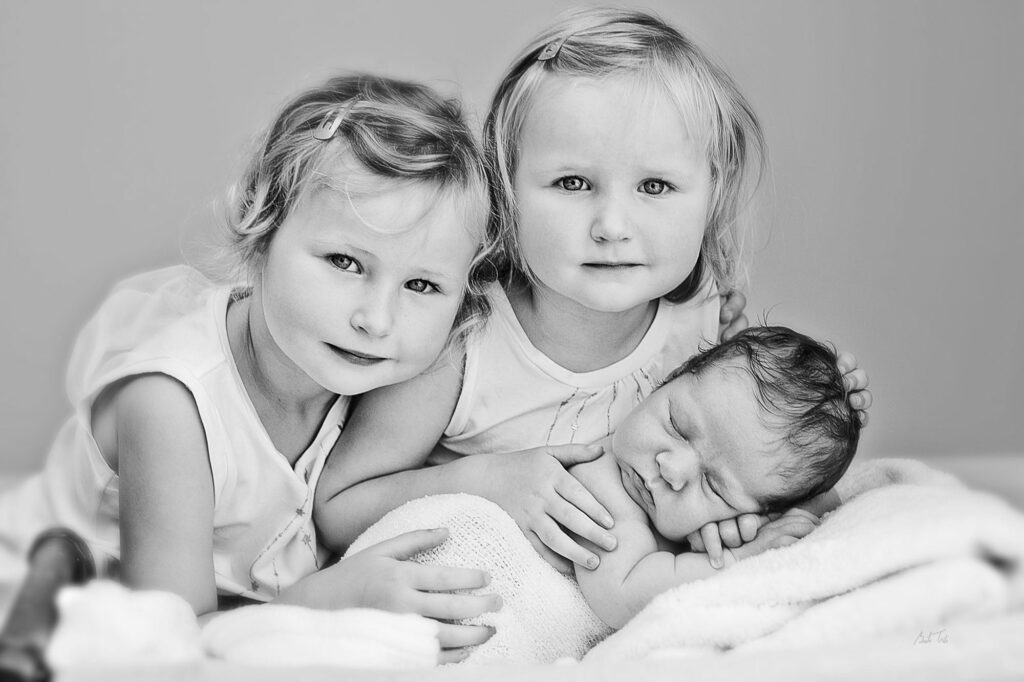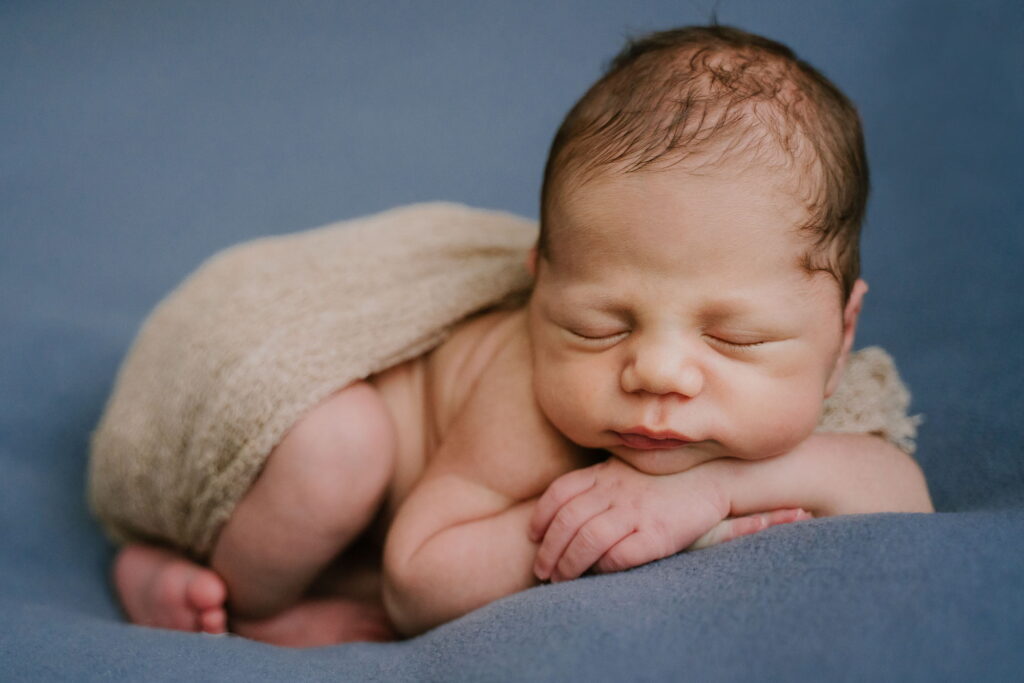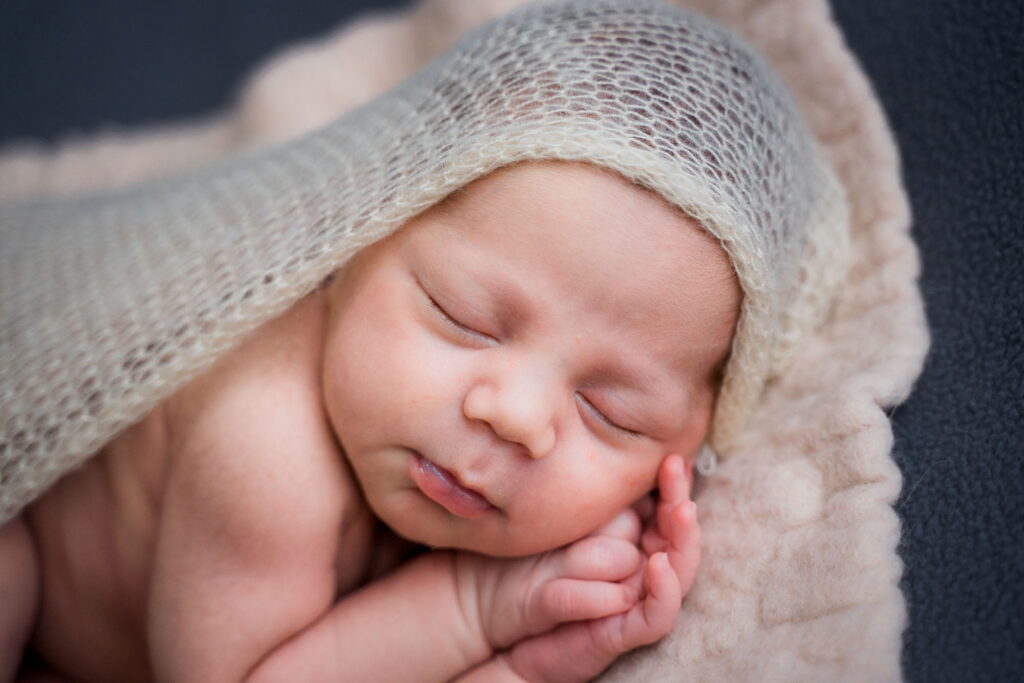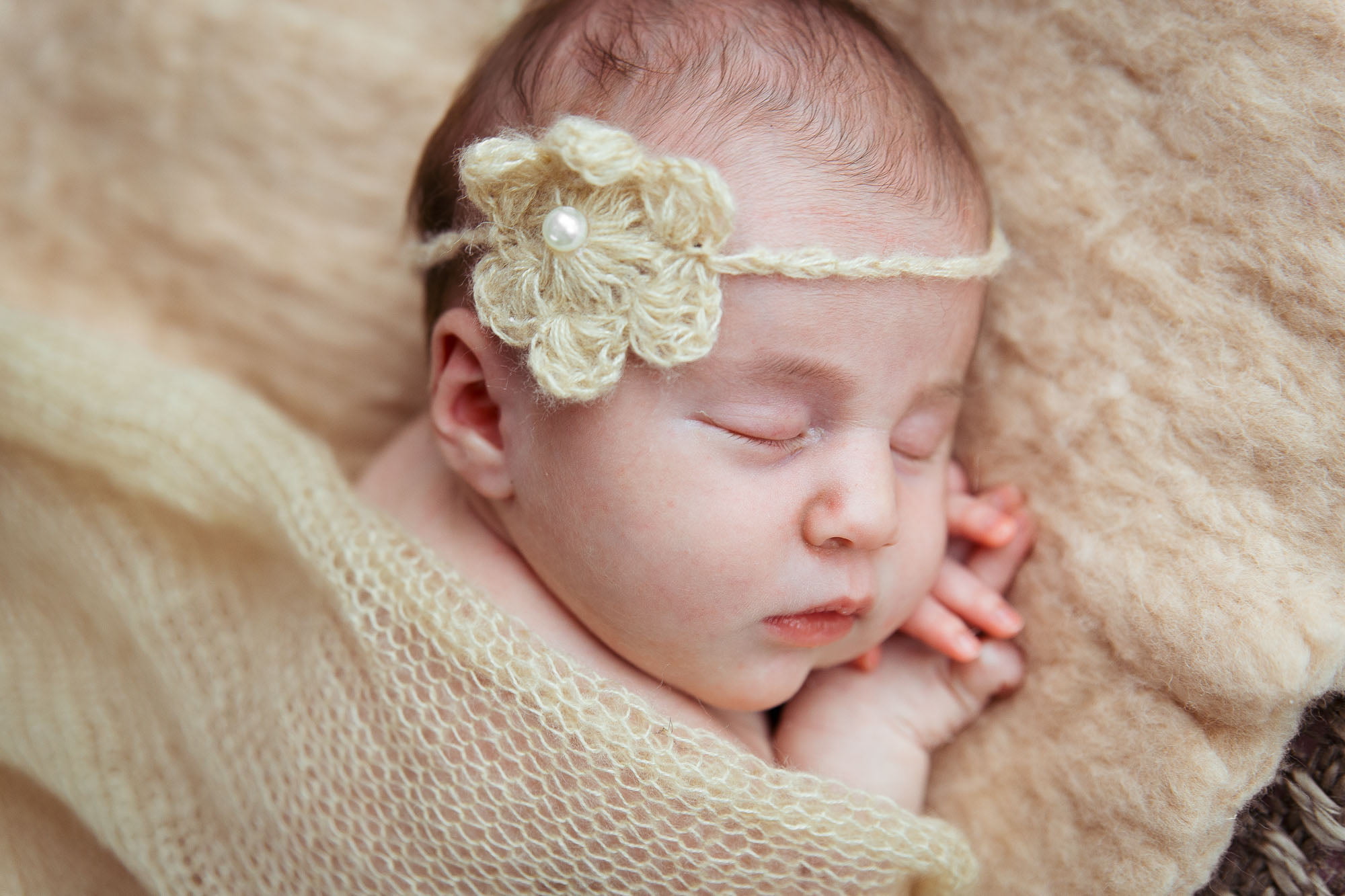
Short answer: Posed newborn photography is directed and sculpted — wrapped, curled, shaped by the photographer. Lifestyle is documentary — you hold your baby, we photograph what happens. Posed makes a graphic, timeless print. Lifestyle makes a print that shows who was in the room. Choose by the one you want on the wall.
This is a question about style, not about where the session happens. You can shoot posed work in a bedroom and lifestyle work in a studio. What separates the two is who is directing the baby: the photographer, or nobody.
Posed: the photographer is shaping every frame
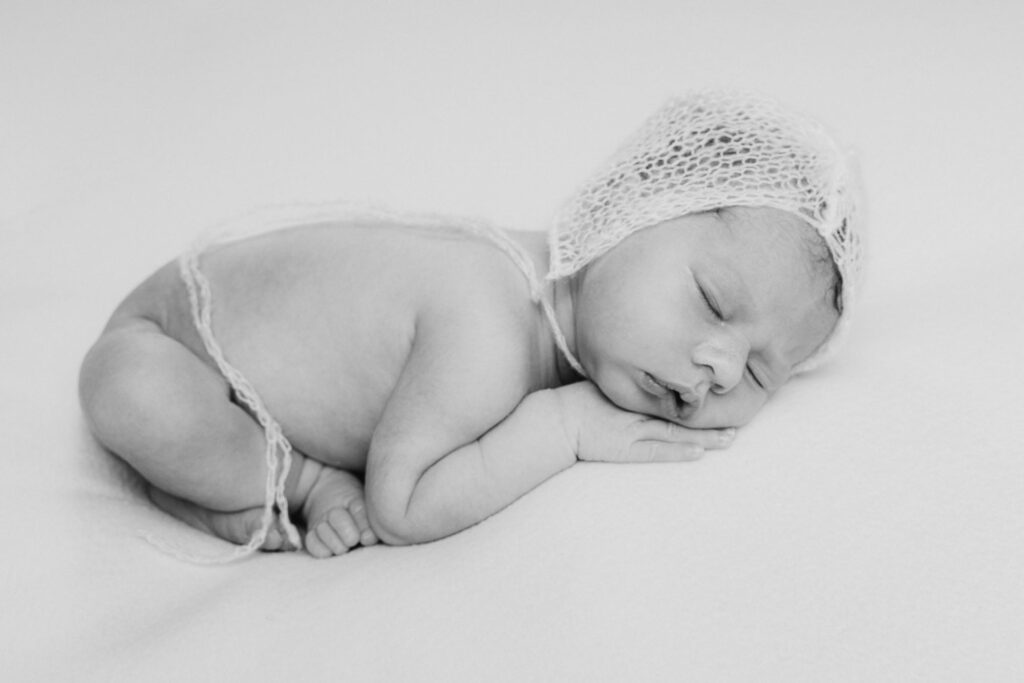
In a posed session the baby is wrapped, settled, and placed. Hands are moved into position a millimetre at a time. A shoulder is nudged. A blanket is smoothed out of frame. Between each setup there is a pause of several minutes where the baby is resettled before anything else happens.
The result is deliberately graphic — clean background, no distraction, symmetrical, the whole picture reduced to the shape of a sleeping baby. It belongs to a tradition closer to sculpture than to reportage, and it is the reason those images print so well large. There is nothing in them to compete with.
It also asks a lot of the timing. Shaping a baby like that only works in the first fortnight, while they still hold the curl and sleep through handling.
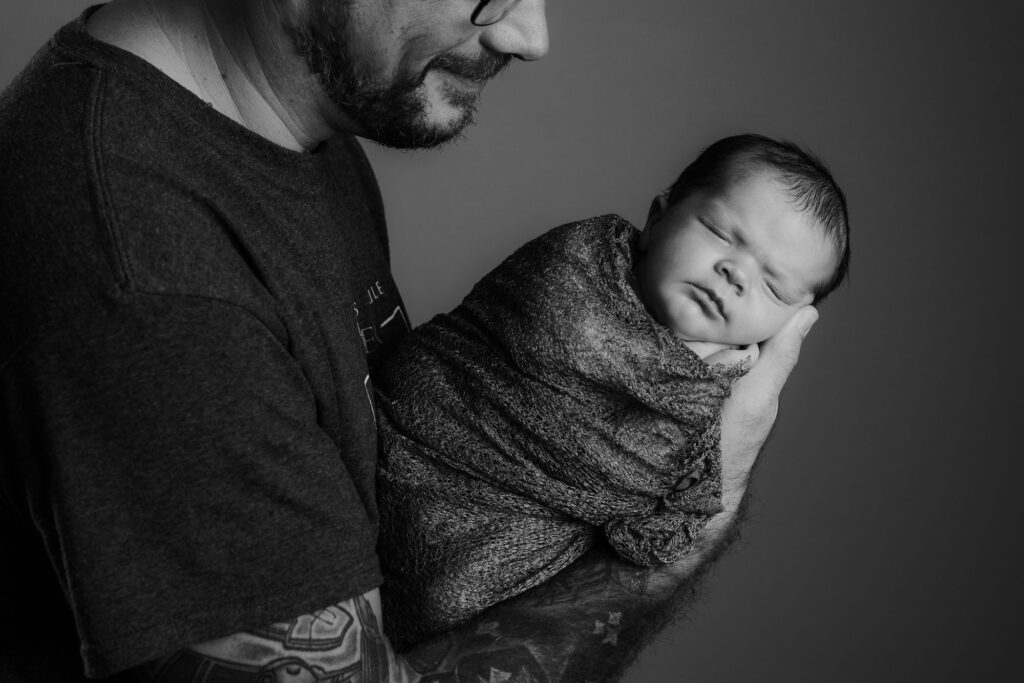
Lifestyle: we stop directing and start watching
A lifestyle session has the baby in your arms, on your bed, against your chest. We might ask you to turn towards a window or move a pillow, and then we stop talking. If the baby cries and you soothe them, that is a photograph. If your four-year-old climbs on the bed uninvited, that is a photograph.
What comes back is messier and warmer. Your hands, with your rings on. The bassinet in the corner. A partner half in shadow looking down. It reads as a specific morning in a specific family’s house rather than a beautiful newborn in the abstract.
The honest cost: some frames will have a wrinkled sheet, a bit of clutter, a nightgown you would not have chosen. That texture is the whole point of the style, and if it will bother you on a wall, you want posed.
What each one is good at on a wall
This is how we actually help people decide, because a photograph’s job is to hang somewhere.
Posed prints go big and go anywhere. A single wrapped portrait at 60 by 90 centimetres in a hallway holds up for decades, because there is no dated furniture or fashion in it. It works in black and white better than almost anything else we shoot. It is the image grandparents want a copy of.
Lifestyle prints work in sets, and work close. One documentary frame alone can look slight. Three or five of them in a row, or in an album, tell the story of a morning. They belong in a bedroom or a hallway you walk past at close range, where the detail rewards you. They also age differently — in twenty years the dated bedside lamp becomes the best part of the picture, not the worst.
If you are weighing up print formats, framed print, canvas or album gets into which suits which.
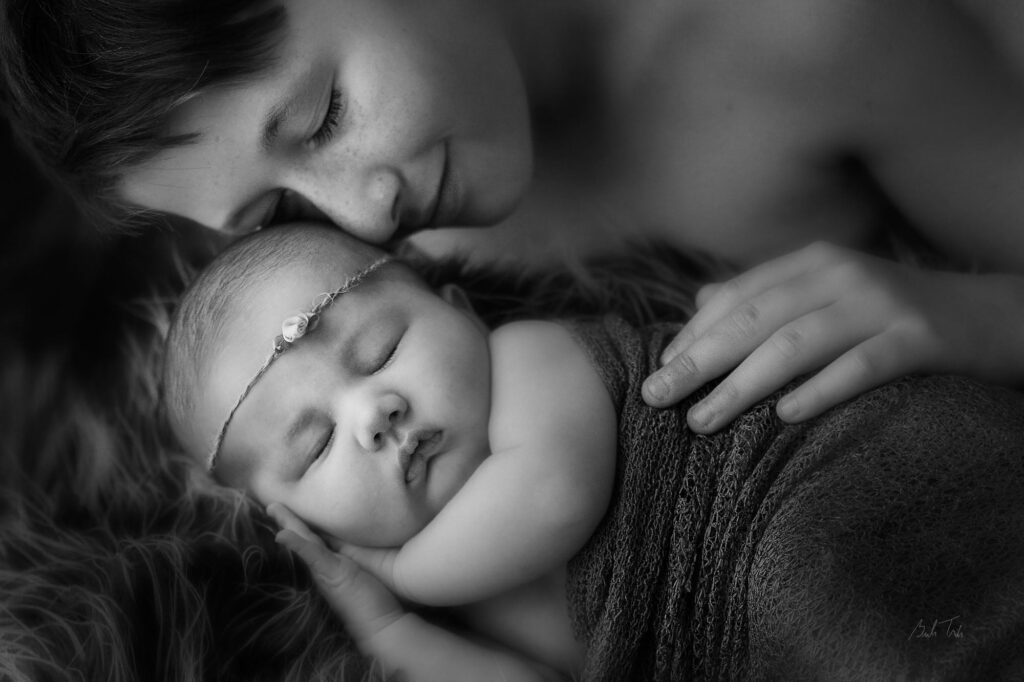
What each one asks of you on the day
Posed asks for patience and not much else. You will spend large parts of the session sitting down while two other people settle your baby. Bring food. For a mother still recovering, that passive role is often a relief.
Lifestyle asks you to be in it, and to be photographed. That is harder than it sounds eleven days after giving birth, when you are not feeling like yourself. Most parents who tell us they hate being photographed relax by about the twenty-minute mark, but we would rather you know upfront that the style puts you in frame as much as the baby.
Lifestyle is also the friendlier style when there is a toddler in the house, because nothing depends on silence.
The safety difference is real
Every advanced posed setup — the propped chin-on-hands, the hanging sling, a baby appearing to balance unsupported — is made from two or more frames with an adult’s hands present in each, merged afterwards. Done properly it involves a spotter with a hand on the baby at all times and a camera that does not move.
Lifestyle work largely sidesteps that, because the baby is never asked to do anything they would not do by themselves. It is not that posed work is unsafe; it is that posed work has standards you need to check for, and lifestyle has fewer places to go wrong. If you are booking posed, ask directly how those images are made. Newborn photography safety lists the questions.
Timing pushes the decision more than taste does
Posed has a hard window. Past roughly two weeks, a baby straightens out and wakes when handled, and the sculpted look stops being achievable. Lifestyle has no window at all — it works at six days, six weeks or six months, because being held is being held.
So if your baby is already three weeks old, the decision has partly been made for you, and that is not a bad outcome. The reasoning is in newborn photos after four weeks.
Can you have both in one session?
Yes, and most of what we shoot is a blend — the posed work first while the baby is deepest asleep, then the family frames once everyone has relaxed and the baby is more likely to be awake. That order matters. Doing it the other way round wastes the sleepiest hour.
The trap is asking for an even split and getting a thin version of each. Tell us which one you actually want the wall print to be, and we will spend the good sleep on that and treat the rest as a bonus.
What does each style look like inside a three-hour session?
The difference shows up in the clock, not just the pictures. In a posed session, much of the time is waiting. The baby is fed, wrapped and settled, then we shoot for a few minutes before the next resettle. Parents sit and watch, which suits a tired mother.
In a lifestyle session there is very little waiting. We are working the whole time, but quietly, from a distance, while you do what you would do anyway: feed, cuddle, change a nappy, sit on the bed. The camera follows you, not the other way round.
Neither is better. They simply ask for different energy from you. Be honest about which kind of morning you can manage.
Which style suits which family?
If you have a toddler
Lifestyle usually wins. A toddler cannot hold still for a long posed run, and in a lifestyle session their wandering is part of the picture. If you want posed frames as well, tell us, and we will do those first while the toddler is occupied with another adult.
If you are a first-time parent who feels out of your depth
Posed can feel easier, because someone else is handling the baby and you are only asked to watch. Lifestyle can feel exposing, because you are the subject. Neither is wrong. Ask yourself which you will resent less at hour two.
If a grandparent is paying for the prints
Ask what they would hang. Many grandparents want one large, quiet portrait. Many also treasure the frame of their own child holding the baby. You can ask for both and we will plan the order.
If the baby is already past two weeks
Deep, curled posing gets harder as the baby straightens and wakes more easily. Lifestyle carries on working at any age. Our piece on newborn photos after four weeks covers this in more detail.
Three things people get wrong when choosing
Choosing by Instagram. A feed of wrapped babies in baskets is a trend. Ask whether you would still want it on a wall in fifteen years.
Assuming lifestyle is less work to prepare for. It is not. The room, the light and your clothes matter more, because they are all in the frame.
Treating the choice as permanent. You can do one style now and the other at a later session, when the baby is awake, smiling and sitting up.
Your pre-session checklist
- Decide which single print you most want on the wall, and tell us.
- Photograph that wall and send it, so we can think about proportions.
- Choose plain, comfortable clothes for yourself, as you will be in frame if you pick lifestyle.
- Pack food for yourself, because posed sessions are long and quiet.
- Line up one adult to mind an older child.
- Ask your midwife or doctor if anything about the baby’s health affects how long they can be handled.
How do the two styles differ in the editing and the print?
Posed frames tend to be finished cleanly and consistently, so a set sits together as a matching group. Lifestyle frames vary more, because the light and the room change from one to the next. That is fine for an album, where variety is the point, but if you want three matching frames in a row on one wall, tell us at the start so we shoot with that in mind.
Black and white also behaves differently. It simplifies a posed portrait into pure shape, while in a lifestyle frame it quietens a busy room so faces and hands stand out. Neither is a rescue for a weak picture, but both are worth asking about.
A worked example
A couple from Ryde tell us they have a long, narrow hallway and want one piece to fill it. We suggest a tall, quiet posed portrait, because a hallway is viewed quickly and from a distance, and a simple shape reads at a glance.
Then they mention a bedroom wall beside the bed, where they see the picture first thing every morning. That wall is close range, and a loose group of lifestyle frames rewards that closeness.
Two walls, two styles. We plan the session around posed frames in the sleepy first stretch, followed by family frames on the bed once the baby is fed and calm. The decision came from the walls, not from a style label.
If you have two walls and cannot choose, do what they did. Measure the viewing distance for each. Far means posed. Near means lifestyle.
Common questions
Is lifestyle newborn photography cheaper?
Not usually, and it surprises people. It takes less equipment but the same time and the same editing, and the skill sits in the shooting rather than the setup. Across Sydney the two styles sit in the same price band. If someone prices lifestyle much lower, ask whether the difference is time, image count or experience.
Which style do grandparents prefer?
Almost always posed — the clean, wrapped, sleeping portrait is the one that gets printed and put on a mantelpiece. Parents, in our experience, come back to the lifestyle frames more often over the years. That split is worth knowing if you are buying prints as gifts.
Do I need to tidy the house for lifestyle photos?
Clear the one room we will work in, make the bed with plain sheets, and stop there. Nobody needs to see the rest. Plain white or grey bedding and a clear bedside table do more for those photographs than a full day of cleaning.
Does posed always mean lots of props?
No. There is a whole approach to posed work that uses nothing but a neutral wrap and a plain surface, and it is the version we lean towards. Buckets, crates and oversized flowers date quickly. A wrapped baby on a plain backdrop does not.
What about black and white?
Both styles work in black and white, for different reasons. Posed portraits become pure form once colour is removed. Lifestyle frames get their emotion sharpened, because the clutter recedes and faces and hands come forward. We usually deliver a mix and let the wall decide.
Pick by the wall, not by the style name
Stand in the room where the photograph is going to live. If you picture one large, quiet portrait that will still look right when your child is twenty, book posed. If you picture a small group of frames that make you remember what those first weeks actually felt like, book lifestyle. If you walk past that wall every day at close range, lifestyle usually wins; if it is the first thing visitors see, posed usually does.
Email us at info@tzportraits.com with a photo of the wall and which of those two descriptions sounds like you, and we will plan the session around that print rather than around a style label. Working backwards from the wall is the only method we have found that stops people ending up with four hundred files and nothing hanging up.
Newborn portraits in our Epping studio
A warm, quiet studio, plenty of time and your baby's pace. Parents and siblings are welcome in the frame.