Short answer: Twin newborn photography needs more hours and fewer setups than a single baby. Twins usually arrive early, so the settled window is earlier and shorter. The real challenge is not posing two babies — it is that two babies almost never fall asleep at the same moment.
We have photographed enough sets of twins in Sydney to be blunt about it. A twin session is not a newborn session with an extra baby dropped in. It is a different job, and a photographer who prices it and schedules it identically to a single-baby booking has not thought about it properly.
Twins arrive early, so the calendar moves
Most twins in Australia are delivered somewhere around 36 to 37 weeks, and many earlier than that. Plenty spend time in special care before they come home.
That matters because the sleepy, curled, easily-posed stage is tied to how far along a baby is, not simply to how many days since the birth. Twins born at 35 weeks who spend a fortnight in hospital may still photograph beautifully at four weeks old, because developmentally they are where a full-term baby is at a fortnight.
The practical version: do not lock a date against a due date the way you would with a single baby. Contact us when you know your delivery plan, then again when they come home, and we book from there. We keep a couple of slots loose each week for exactly this.
If you are reading this while still pregnant, the broader timing question is covered in when to book a newborn session — just read it knowing your window will probably sit later than the dates it gives.
The sleep problem nobody warns you about
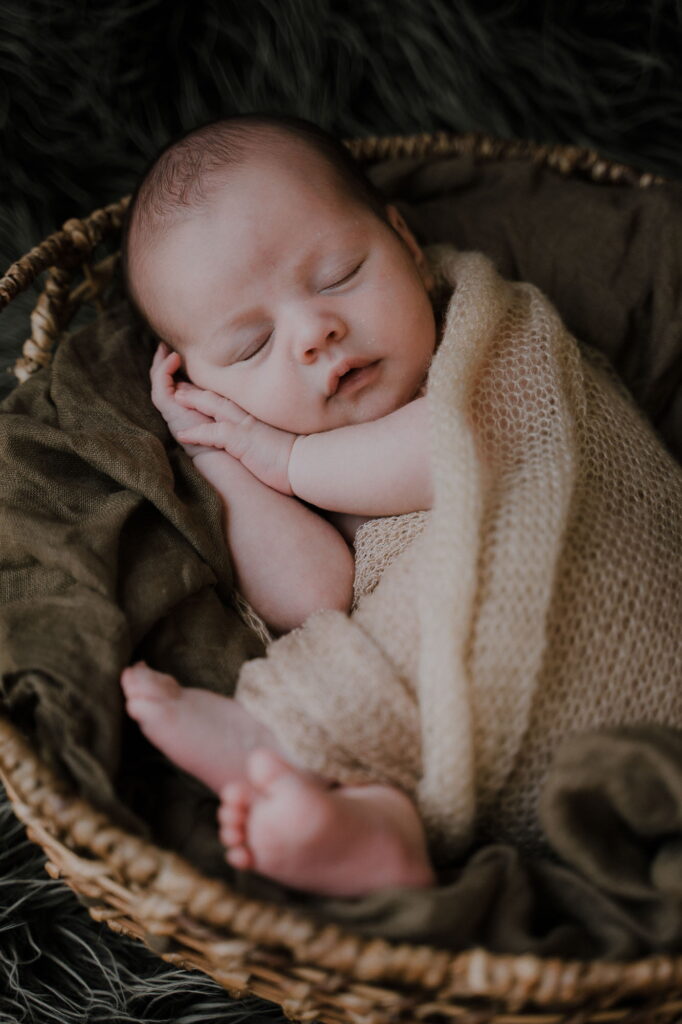
Here is the thing that actually defines a twin session. Two babies rarely sleep at the same time.
With one baby, the session is a loop: settle, photograph, re-settle. With two, you are running that loop twice, out of phase. Baby A goes down. Baby B wakes for a feed. By the time B is settled, A has surfaced and needs winding.
Waiting for both to be deeply asleep simultaneously can take a very long time, and it does not always happen at all. So we do not build the session around the assumption that it will. We photograph each baby on their own while the other is being fed or held, and we treat the together frames as something we catch when the window opens rather than something we schedule for 11am.
That is why a twin session runs four hours or more at our studio rather than the usual three. The extra hour is not extra photographs. It is waiting room.
Fewer setups, better setups
The instinct with twins is to want twice as much. Twice the outfits, twice the backdrops, twice the variety.
The opposite is true. Every setup change costs you two babies being moved, re-settled and re-warmed. Three changes with twins costs about as much time and disruption as six with a single baby, and by the fourth change you have two unhappy newborns and a room that feels like a shift change.
We plan three setups for twins and that is it. One together, one individual pair on the same background so the frames hang as a set, one with parents. Everything else is variation within those, shot from different angles and distances.
| Setup | Roughly how long | Why it is on the list |
|---|---|---|
| Together, side by side | 45–75 minutes | The one frame that only exists because they are twins |
| Individual portraits, matched background | 40 minutes | Each child gets their own picture; they hang as a pair |
| Parents holding both | 25 minutes | Two babies, four arms — easiest while everyone is awake |
| Feeding, winding, settling | The rest | Unavoidable, and doubled |
Posing two babies safely
A single newborn can be supported by one spotter. Two babies touching each other cannot, because each one can shift the other.
So every together frame in our studio has two adults within arm’s reach — usually Lin and a parent, sometimes both parents while Binh shoots. Nobody is more than a hand’s width from a baby. The hands come out of the photograph in editing; they do not come out of the room.
We also keep the babies on a flat, firm surface for together frames rather than propping them in anything. The dramatic bucket and hammock shots you see online are single-baby setups, and doubling them doubles the risk for very little gain. Our position on this sits alongside what we cover in newborn photography safety.
Identical, fraternal, and telling them apart later
This sounds trivial until you are editing 400 frames. With identical twins, parents can very often tell who is who in person and cannot in a photograph.
We solve it in the room. Each baby keeps a consistent side through every setup, we note which wrap colour belongs to which child, and we photograph one frame at the start of each block with the names visible on a card. It costs thirty seconds and it means the final gallery is labelled correctly.
Ask your photographer how they handle this. If they have not thought about it, you will be the one squinting at a print in five years wondering which one is which.
What it costs in Sydney
Sydney studios generally treat twins as a surcharge on their standard newborn session rather than a separate product. Across the studios we see quoted, that surcharge tends to land somewhere between $150 and $400 on top of the session fee, reflecting the longer booking and the second photographer or assistant many studios bring in.
Some studios charge nothing extra and simply run longer. That is not automatically better value — check whether the session length actually increases, because a twin session squeezed into a two-hour single-baby slot is how you end up with three usable photographs.
The question worth asking is not the surcharge. It is how many hours are booked and how many adults will be in the room.
What does a twin session actually feel like, minute by minute?
Parents often arrive expecting a smooth routine and are surprised by how much of the session is waiting. Knowing the rhythm beforehand takes the pressure off. Here is how a typical twin morning tends to unfold, in the order it usually goes. The timings vary from family to family and baby to baby, so treat this as a shape, not a schedule.
- Arrival and settling. Both babies are fed if they need it, and everyone gets a few minutes to adjust to the room. Parents often use this time to breathe. We use it to watch how each baby behaves, because no two babies share a rhythm.
- The first baby goes down. Whichever is sleepier gets photographed first while the other is held, fed or wound by a parent or helper. This is the quiet start and usually produces the easiest frames.
- Swap. The second baby is photographed while the first is fed or held, and this may happen more than once.
- The together attempt. When both are calm, even if one is drowsy and the other awake, we try the side-by-side frame. If it does not hold, we stop and try again later rather than force it.
- Parents with both. This is easier when both babies are awake and held, so it often comes in the second half.
- A last go at the pair. Having rested and fed, the babies are often in better shape for a final together frame.
Notice there is no point at which we say “now we have an hour of twin photographs”. The photographs come in pieces, and that is the honest reality of two newborns in one room.
How can you prepare at home so the morning goes better?
Two things help more than anything else, and neither involves buying anything.
First, keep a simple feeding diary for each baby for a few days before. Write down when each one feeds and when each one sleeps. Within two or three days a pattern usually appears, even if it is rough, and you can tell us, which helps us plan which baby goes first. Do not try to force the babies onto the same schedule just for the session. That tends to backfire.
Second, arrange a helper. One extra pair of hands lets a parent step into a photograph rather than stay behind the scenes. A grandparent, a sibling of the parents or a close friend is ideal. Ask them to bring a calm presence and no opinions about posing.
If either baby spent time in special care, or has any feeding or health considerations, talk to your paediatrician or midwife about whether and when to travel, and let us know what they say. We follow your medical team’s guidance, not the other way round.
For the packing list, our article on what to bring to a newborn session is a good base. With twins, double the essentials and label everything. Here is the version for two.
- Two sets of every feeding item: bottles, formula, expressed milk, burp cloths
- Spare outfits and nappies, with enough for two changes each
- Something to tell the babies apart, such as a small band or a coloured wrap for each
- Your feeding diary, so we know who is likely to wake first
- A helper, with a clear job: holding, winding or settling
- Any small family keepsake you would like in a frame
What goes wrong, and what we do about it
One baby is asleep and the other is furious. We photograph the settled one, let the other be fed and held, and do not rush. A parent who feels guilty about a crying baby usually makes the moment longer, not shorter. Crying twins are normal in a twin session and nobody in the room is surprised by it.
Both are awake and neither wants to sleep. Awake twin photographs can be lovely. Hands touching, eyes wide, a yawn caught at the right second. We shift to that kind of frame and stop trying to produce sleeping poses.
The parents run out of energy. This is common, and it is the main reason to have a helper. We schedule breaks and offer tea or water. A parent who sits down for five minutes is a better photographic subject than one who has been standing for two hours.
When the gallery arrives, one choice is worth making slowly. The two individual portraits against the same background are designed to hang as a pair, so choose them together and print them the same size. Hung side by side at the same height on the same wall, with the same frame, they stop looking like two photographs and start looking like one piece about two people. Our guide to where to hang family portraits helps you choose the wall.
Common questions
How late is too late for twin newborn photos?
Later than people think. Because twins are often born early, many still photograph as classic sleepy newborns at four or five weeks. We have had good sessions at six weeks with babies born at 34 weeks. Send us their birth date and gestation and we will tell you where the window sits.
Do we need to bring extra help?
Yes if you can. A grandparent or friend whose only job is to hold, wind or walk a baby makes an enormous difference, because it means a parent is always free to be in a photograph rather than mid-feed. Two parents alone can manage, but it is harder work.
Will both babies be asleep in the together shot?
Sometimes, and we plan for it without depending on it. Awake twin frames can be lovely — eyes open, hands touching, both looking somewhere near the ceiling. Some of our favourite twin photographs have one asleep and one wide awake, which is honestly what the first month looks like anyway.
Can our older child still be part of it?
Yes, and we photograph them first, early, before the twin work begins. With two babies to manage, an older sibling waiting around for their turn is more than the room can carry.
What should we feed them before we arrive?
Feed as normal on the way or on arrival, and expect to feed again during the session. There is no way to time two babies onto one schedule for a morning, and trying to is more stressful than simply letting it happen in the room.
Give it the time it needs
If you are booking twins, the thing to protect is the calendar, not the shot list. Block the whole morning. Do not schedule anything afterwards. Accept that the together frame might happen at hour one or hour four, and that having space for either is what gets you the photograph.
Tell us the gestation, the birth date and whether they are home yet when you email info@tzportraits.com, and we will hold a longer slot from the start rather than trying to stretch one later.
Newborn portraits in our Epping studio
A warm, quiet studio, plenty of time and your baby's pace. Parents and siblings are welcome in the frame.