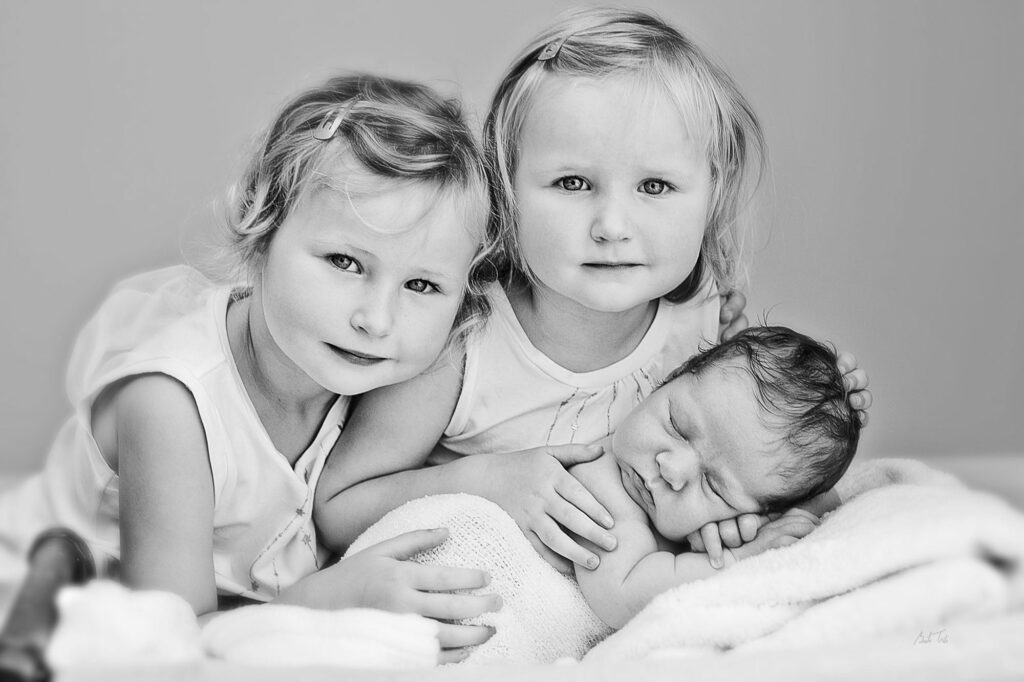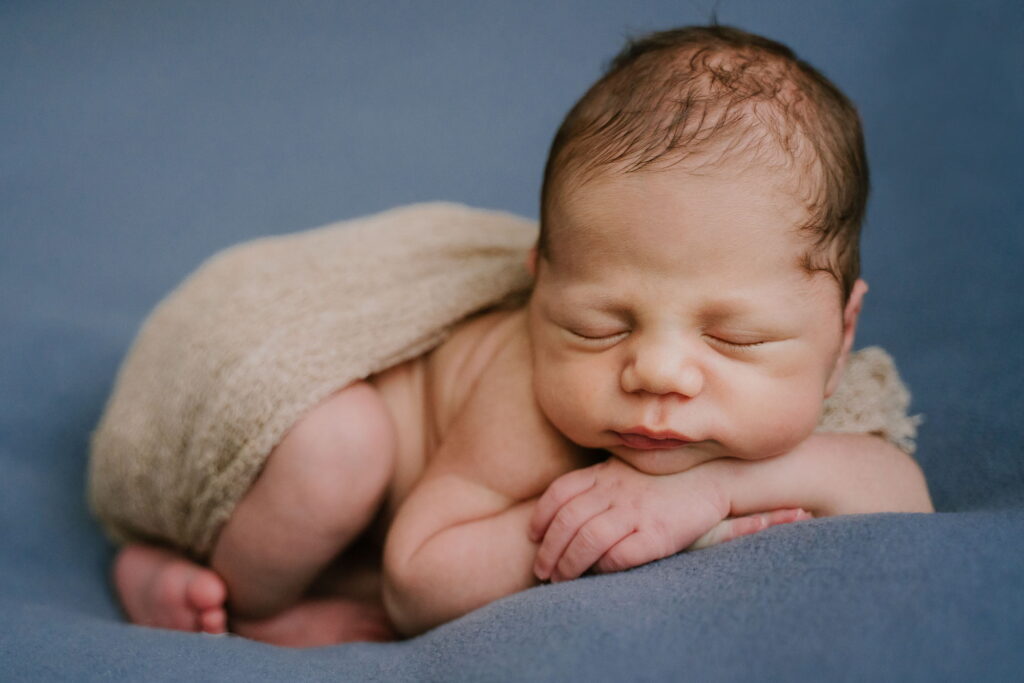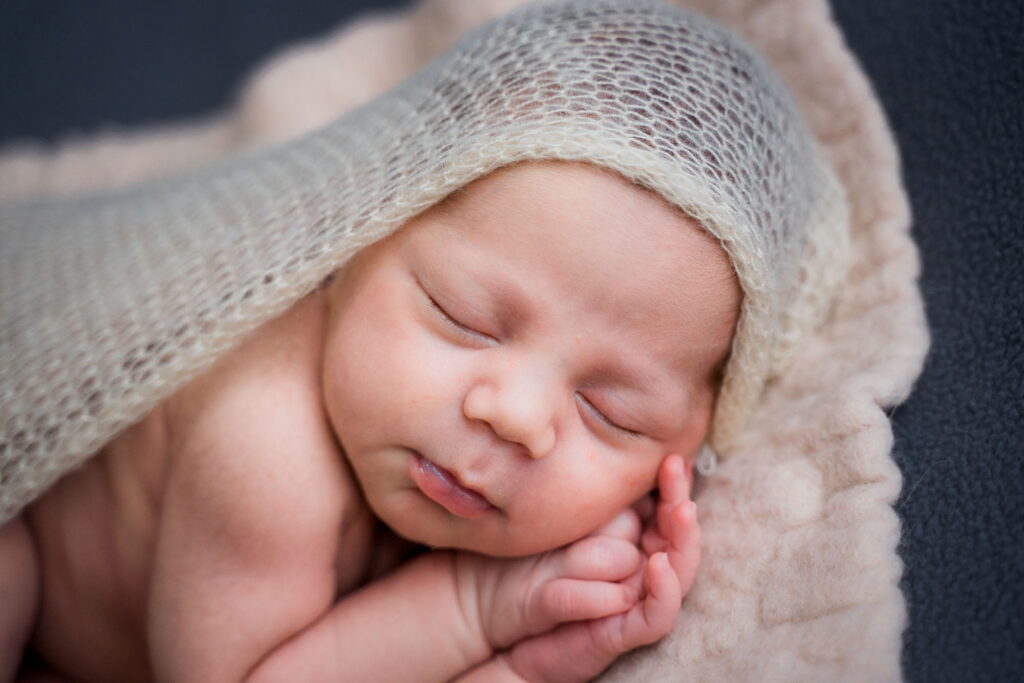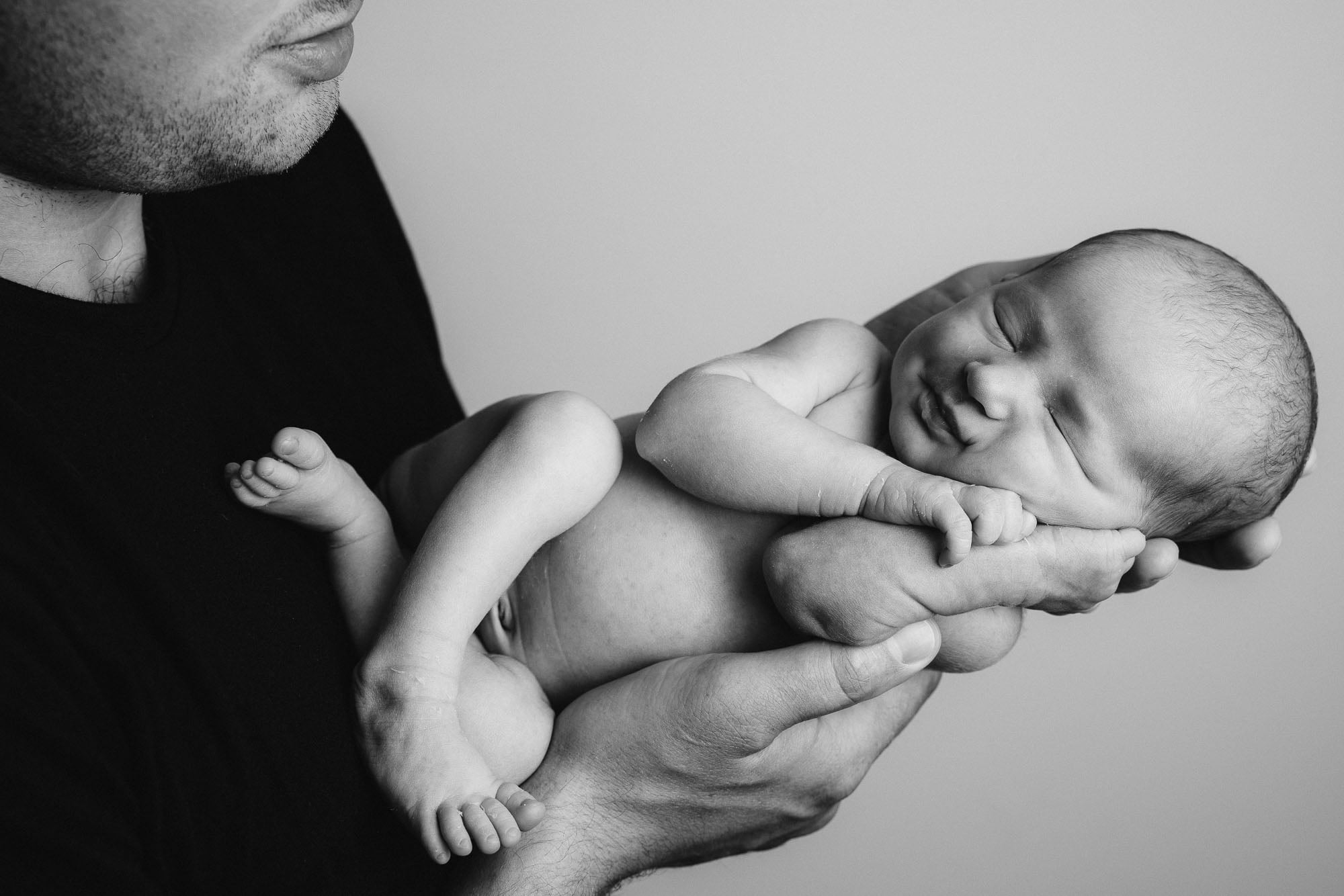
Short answer: Wear solid, muted colours with sleeves, and nothing carrying a logo or a pattern. The baby is usually in a plain wrap or nothing at all, so what parents wear decides the whole look of the photographs. Half the frames have an adult in them.
Search this question and you will get twenty articles about the baby. Bonnets, wraps, tiny knitted trousers. Almost none of them mention that you are in the pictures too, wearing whatever you grabbed at 6am while holding a nine-day-old.
We would rather talk about the adults, because that is the decision that actually changes the photographs.
Why the baby’s outfit barely matters
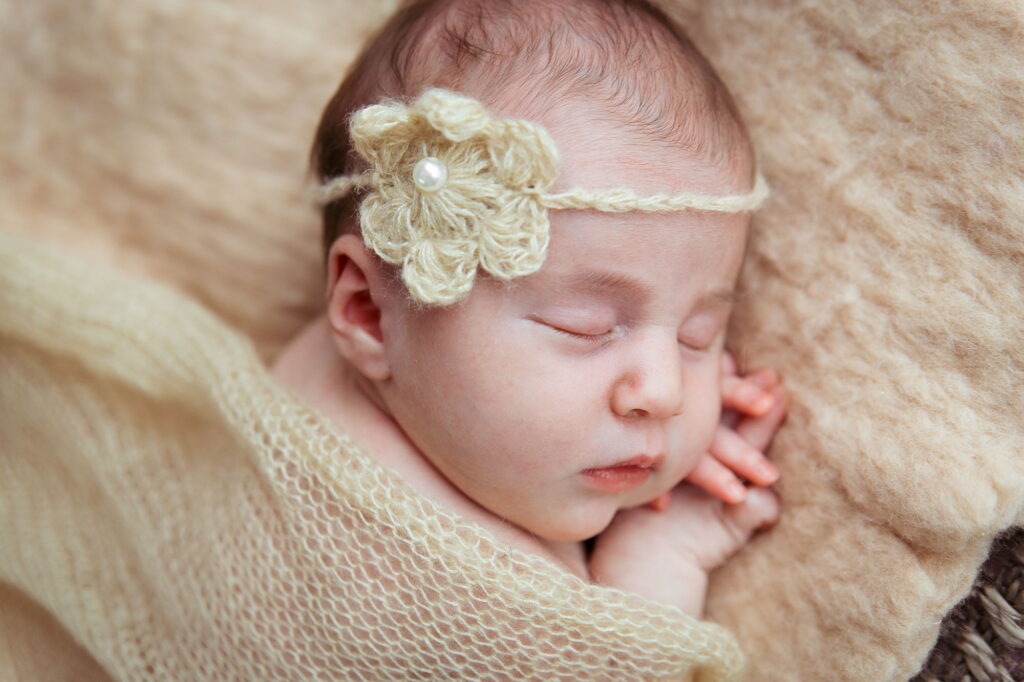
For most of a studio session, the baby is wrapped in a neutral stretch fabric that we supply, or lying on a plain surface in a nappy. That is not laziness. A newborn’s face and hands are the subject, and clothing adds shapes and colours that compete with skin.
So if you have been agonising over a little outfit, relax. Bring it if it means something — the cardigan your mother knitted, the gown a sibling wore — and we will photograph it properly. Otherwise the studio wardrobe covers it.
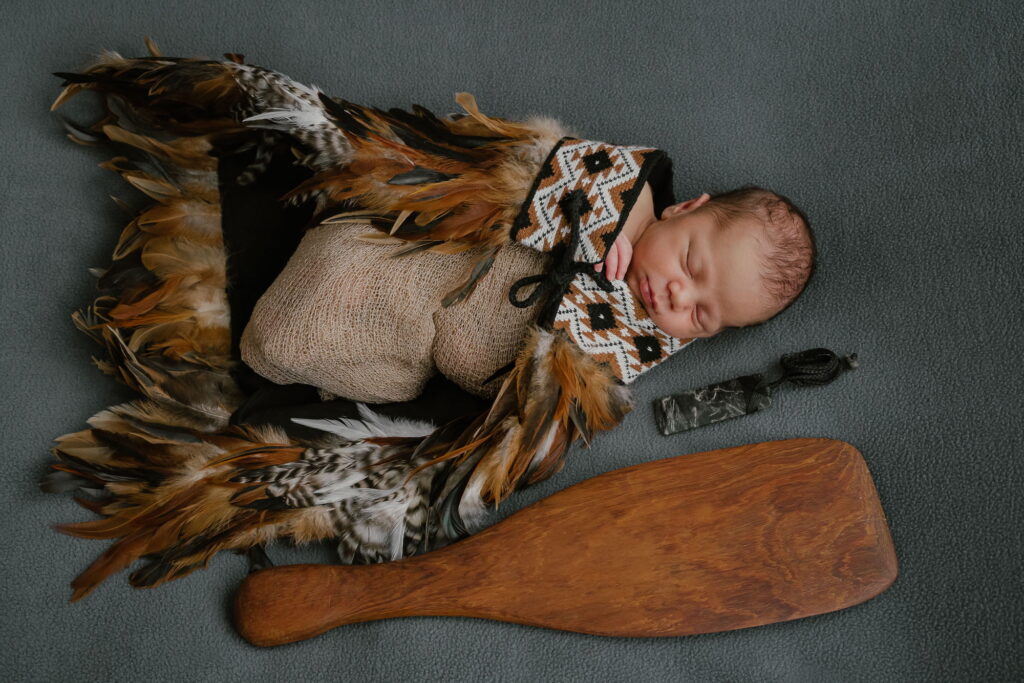
The exception is a cultural or family piece. Those are worth planning around and worth telling us about beforehand so we set a background that suits the colour.
What parents should actually wear
Solid colours. One tone per person, no pattern, nothing with writing on it.
A logo is a date stamp. A branded t-shirt tells anyone looking at the photograph in 2041 exactly which year it was taken, and it pulls the eye straight off the baby’s face. The same goes for a bold stripe or a floral print — in a photograph where the only other colour is skin and cream fabric, a pattern shouts.
Sleeves matter more than people expect. Newborn photography is close work: your hands, your forearms, your chest, the baby. Bare arms take up a lot of frame and, being bright, they draw attention. Long or three-quarter sleeves quietly solve it. Same reasoning for a higher neckline.
And the room is warm — around 26 degrees, because the baby is undressed. Something breathable in a long sleeve beats something heavy.
| Works well | Causes problems |
|---|---|
| Soft grey, oatmeal, dusty blue, sage, warm white | Bright red, neon, pure black next to pale skin |
| Long or three-quarter sleeves | Singlets, tank tops, sleeveless dresses |
| Plain jersey, linen, fine knit | Logos, slogans, large prints, bold stripes |
| Fitted through the shoulder | Baggy sleeves that bunch when you hold the baby |
| A cardigan you can take off | Anything you will overheat in |
Building a palette without matching
Matching outfits look like a uniform. What you want instead is a family that looks like it dressed on the same morning with the same taste.
The method we give clients: pick one person’s top, usually whoever is fussiest about what they wear, and choose everybody else from tones that sit near it. If mum is in soft grey, dad goes oatmeal or a muted blue, and an older sibling goes warm white. Three shades from the same quiet family, no two identical.
Where there is an older child in the frames, this ties into the running order we describe in newborn photos with siblings — dress that child first and build outward, because they are the one most likely to refuse a shirt on the day.
Things worth doing the night before
Lay it all out. Every garment, for everyone, on the spare bed or the couch. It takes ten minutes and it is the difference between arriving dressed and arriving in the first thing that fit.
Check the clothes are not creased into hard lines. A soft drape photographs well; a fold pressed in from a drawer does not.
Bring a spare top. Not an optional nicety — newborns are unpredictable, and a shoulder covered in milk at the forty-minute mark ends the parent photographs unless you have a change with you.
What not to worry about
Your body. Ten days after a birth, most mothers are photographed in a state they would not choose. We know that, we pose for it, and we light for it. Seated and slightly turned, baby held high against the chest, elbows in — it is a flattering arrangement for anyone and it is what we use by default.
If you tell us what you feel self-conscious about, we work around it silently. Nobody in the room mentions it again. That is a far better plan than trying to hide behind clothing, which usually means baggy layers that photograph worse.
Dads, one note: a plain long-sleeved top and a clean shave or a tidied beard covers it. There is no other preparation required and no reason to buy anything.
Jewellery, nails and the small stuff
Hands are in almost every newborn photograph. Yours, held against a very small head, in close focus.
So: chipped polish shows. A large watch face catches the light and reflects the studio lamp. A ring you never take off is fine and often lovely, but a stack of five bangles will dominate a close-up of your fingers on a baby’s back.
Keep it to what you actually wear. This is not an argument for taking everything off — a wedding ring in a hand photograph is part of the story. It is an argument against putting things on for the occasion.
What do the other people in the photographs wear, and how do we plan it?
Older siblings, grandparents and even a visiting aunt may be in the frame. That makes a small wardrobe problem, and the simplest way to solve it is to decide in order rather than all at once.
Start with the adult who will be in the most frames. Usually that is mum, and she should wear whatever she is most comfortable feeding and moving in. Everyone else is chosen to sit near her tone.
Dress the siblings next. Children are the least predictable, so pick their clothes for comfort first and colour second. A soft top that does not itch and trousers they can sit in will stay on. A stiff collar will come off in the car.
Grandparents last. They often arrive with their own idea of what to wear, and it is perfectly reasonable to ask for a muted top rather than a bright pattern. A short message the day before does the job: “plain colours, nothing with writing, we are going soft and quiet”.
If you are working from clothes you already own, lay them out together on a bed and look at the lot at once from the doorway. Anything that jumps out, whether it is a bright cushion colour or a shiny fabric, is the piece that will jump out in the photograph as well.
What fabric and fit work best when you are newly postnatal?
Practicality counts more here than style. Our general advice is hedged because every body and every birth is different.
- Soft stretch. Jersey or a stretch knit moves with you and does not dig in. It also forgives a body that is still changing from week to week.
- Easy access for feeding. A wrap top, a front-buttoning cardigan or a stretchy neckline lets you feed without rearranging anything. A baby in the middle of a feed is often a settled baby.
- A layer you can remove. The studio is warm, so a cardigan you can take off is more useful than a heavy jumper you cannot.
- Avoid anything that rides up. Holding a baby against your chest tends to push the hems of tops upward. A slightly longer top solves that.
- Underlayers that do not show. A bra strap that slips or a visible seam shows up in close frames. Choose a plain, soft one.
If you are recovering from a caesarean or a difficult birth, wear what feels safe and gentle on your body, and tell us what is sore. Your doctor or midwife, rather than a photographer, is the right person to advise on what you should or should not do after a birth. We will move you and the baby around so you are not reaching or twisting more than you need to.
What goes in the bag for the day?
- Your chosen outfit for each person, plus one backup top for mum.
- Any family or cultural piece you want photographed, wrapped so it stays clean.
- Nappies, wipes and a change of baby clothes.
- A feeding cover or muslin if you use one.
- Water and something easy to eat.
- A plain dark or neutral item for dad if he is unsure.
- Comfortable slip-on shoes for the trip, since they stay off in the studio.
A note on the baby’s own outfit, as it follows from the wardrobe question. If a relative has given a hat or blanket and you want it used, bring it and tell us at the start. We will photograph it properly in a frame of its own, and then put it away so the rest of the session is about skin.
Before you leave home, take one photograph of everyone in their chosen clothes against a plain wall, and look at it for ten seconds. Whatever you find yourself wanting to change in that phone picture is the thing that would have bothered you in print.
Common questions
Can I wear black?
You can, but understand what it does. Against a pale newborn on a light background, black creates a very strong contrast that pulls the eye to the edge of your clothing rather than to the baby. A charcoal or deep grey gives you the same slimming effect with far less fight in the frame.
Do you have clothes we can borrow?
We keep a wardrobe of newborn wraps and a few simple neutral tops in common women’s sizes for parents caught out on the day. It is not a full wardrobe and we would not plan around it, but it has rescued a few sessions after a milk incident.
Should everyone change outfits partway through?
Generally no. Changing adults costs time we would rather spend on the baby, and one good palette photographs better across a whole session than two mediocre ones. If you want a second look, make it a cardigan on or off rather than a full change.
What about shoes?
Bare feet or socks. Almost all our newborn work is seated or lying down on a floor covering, and shoes rarely appear. If they do appear, they look wrong, so we leave them at the door.
My older child will only wear one particular dress. Is that a problem?
Only if it is loud. If it is a busy print, we will position her so it takes up less of the frame and we will lean on the close crops. A fight in the car about a dress costs you far more than a slightly awkward colour does.
Pick the clothes once, then forget about them
The point of all this is not to dress for the camera. It is to make one small set of choices ahead of time so that on the day you are thinking about your baby instead of your shirt.
Solid colours, sleeves on, no logos, and a spare top in the bag. That is the entire brief.
If you have something specific you want to wear and you are not sure it will work, send us a photo of it at info@tzportraits.com before your session. We would much rather answer that question a week early than see it walk through the door.
Newborn portraits in our Epping studio
A warm, quiet studio, plenty of time and your baby's pace. Parents and siblings are welcome in the frame.