Short answer: A newborn session runs about three hours because roughly two of them are feeding, winding and settling. Actual shooting is maybe forty minutes, spread across the morning in short bursts. The clock belongs to the baby, and no photographer can speed that up.
Parents book a newborn session, see three hours in the confirmation email, and quietly panic. Three hours? With a ten-day-old? What could possibly take that long?
Fair question. Here is the honest breakdown of where the time goes at our studio in Epping, and why the answer is not “slow photographer”.
The maths of an unposeable subject
A newborn cannot be directed. You cannot ask for a different expression, you cannot ask them to hold a position, and you cannot ask them to wait five minutes.
What you can do is wait until they are deeply asleep, move them very gently, take photographs for six or seven minutes, and then stop because they have stirred. Then you settle them again. That cycle is the entire job, and each cycle yields a handful of usable frames.
Four or five of those cycles gets you a full gallery. Four or five of those cycles takes about three hours, because the settling half of each cycle is longer than the shooting half. Every time.
Hour by hour, what actually happens
| Time | What is going on |
|---|---|
| 0:00–0:25 | You arrive. We talk, you unpack, the baby usually needs a feed after the drive. We do not start shooting while you are still finding your feet. |
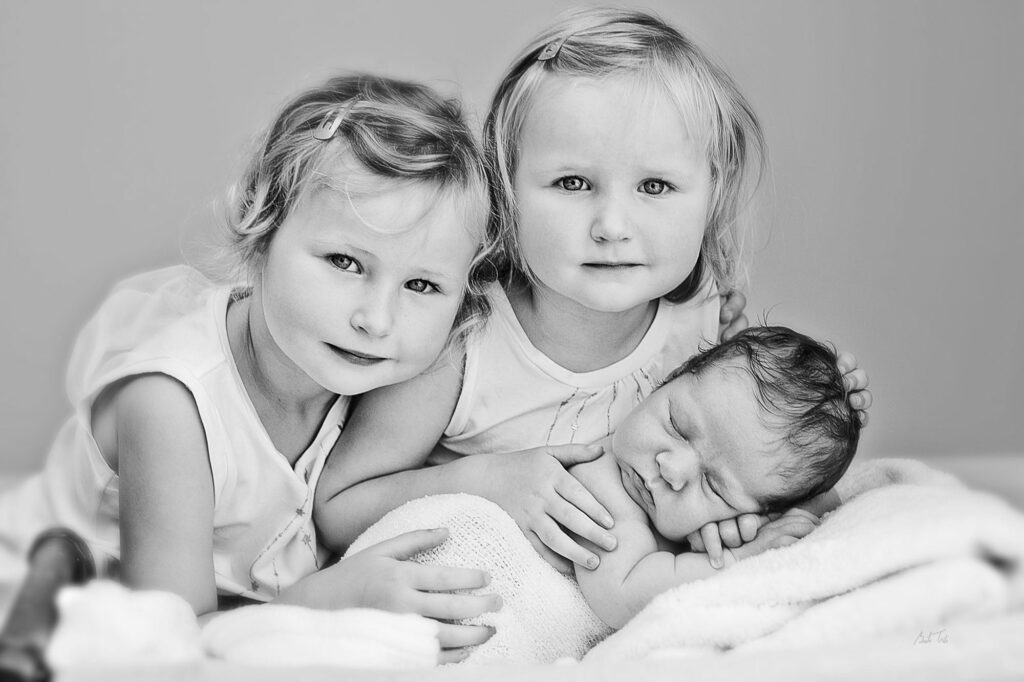
| 0:25–0:45 | Siblings and family frames if there are any, done early while everyone is fresh. |
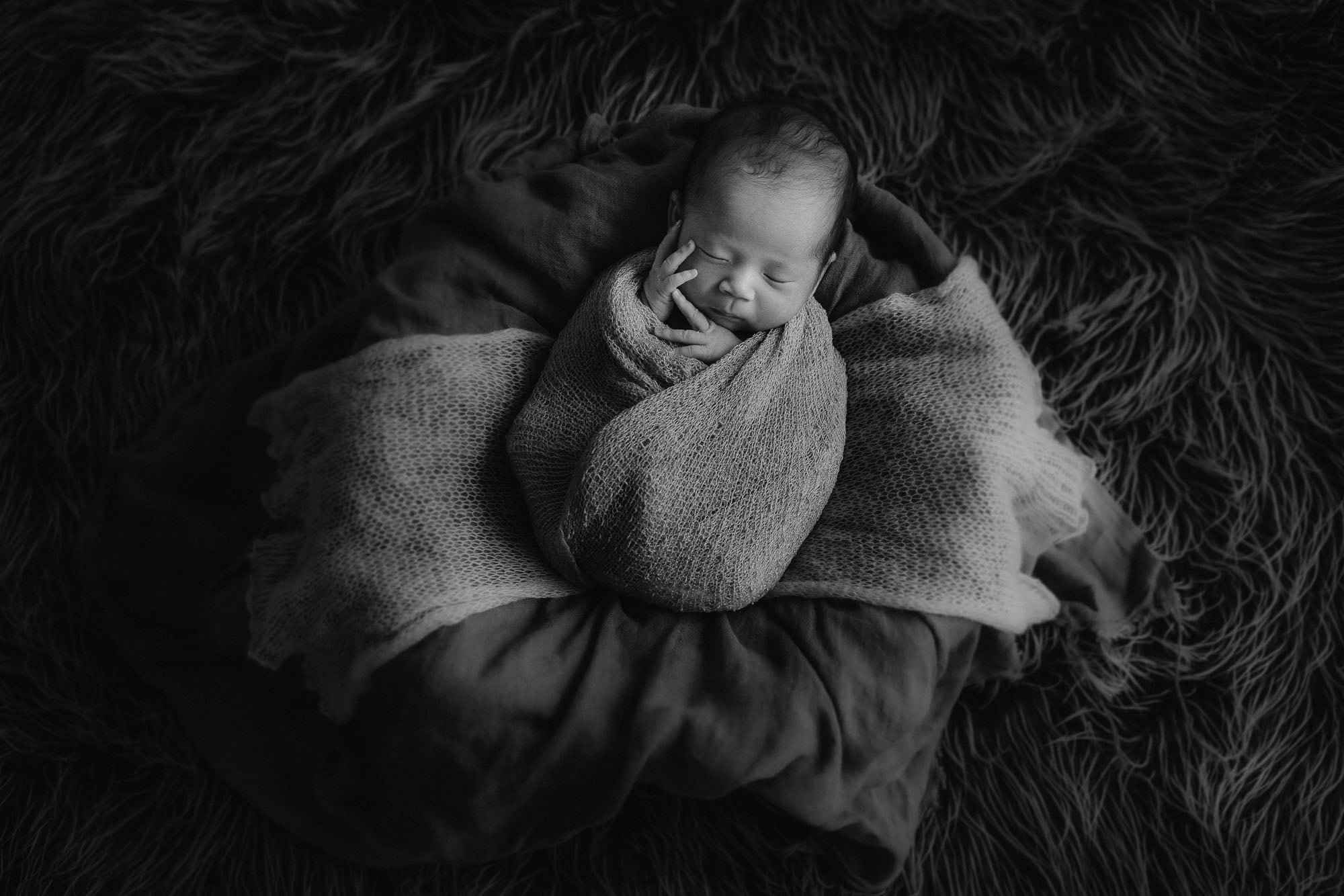
| 0:45–1:15 | First settling. Baby goes down, we photograph the first wrapped setup. |
| 1:15–1:40 | Wake, feed, wind. This is normal and nothing has gone wrong. |
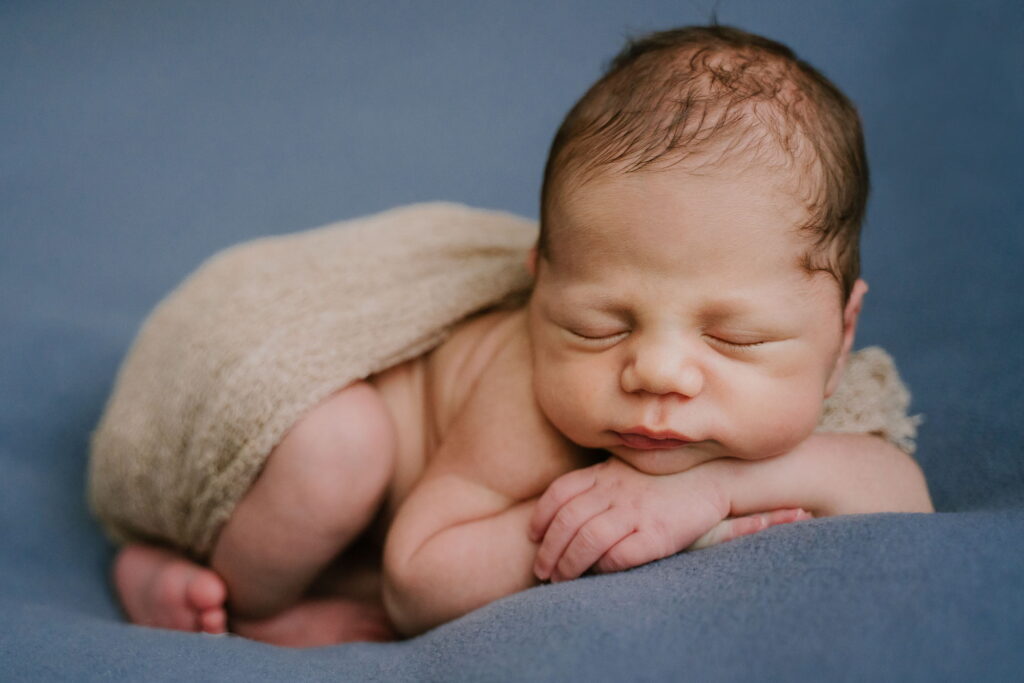
| 1:40–2:20 | Second and third setups. Usually the unwrapped work and the close detail frames. |
| 2:20–2:40 | Another feed, or a nappy change that requires a full reset. |
| 2:40–3:05 | Parent frames. Left late on purpose — you are relaxed by now and the baby is well fed. |
| 3:05 on | Pack down, talk about what comes next. Sometimes we run over. We do not rush this part. |
Look at that table and count the shooting blocks. They add up to somewhere near forty-five minutes out of three hours. That ratio does not change much from baby to baby.
Why the room is kept hot and slow
We hold the studio at about 26 degrees. A warm baby settles; a cool one wakes and grizzles. It means the adults in the room are uncomfortably warm all morning, which is a trade we make every single session.
We also move slowly on purpose. Hands warmed before touching the baby, no sudden noise, white noise running constantly. Every one of those choices costs a few seconds and saves ten minutes of re-settling. Working faster in the moment makes the session longer overall, which is counterintuitive until you have watched it happen.
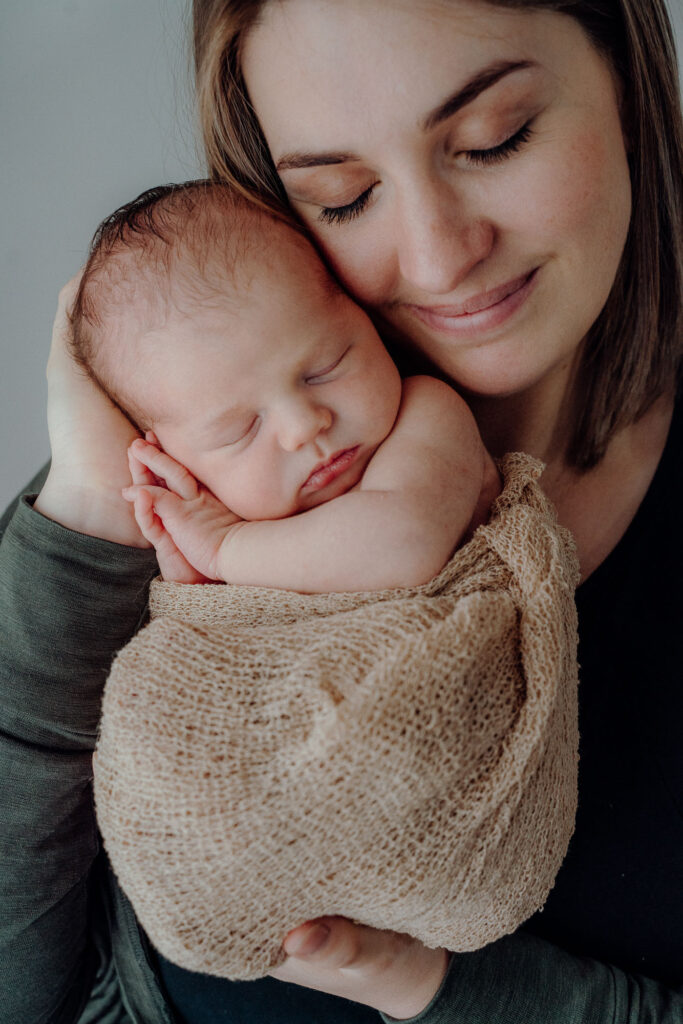
What makes a session run short, and what makes it run long
The fastest sessions we have had were about two hours. The longest was closer to five. The difference was almost never the photographer.
Short sessions tend to have a baby under two weeks old, a good feed just before arrival, no older siblings, and parents who brought food for themselves and are not watching the clock.
Long sessions tend to have a baby with reflux or wind, a feed that did not go well, or a family with a lunch booking at one o’clock. That last one is worth naming plainly: nothing slows a newborn session down like a parent who needs it to be finished by a certain time. The tension travels.
Age is the other lever, and it is covered properly in newborn photos after four weeks. Older babies are awake more, which is not a problem, but it does change what we shoot rather than how long it takes.
What you should do with the time
Eat. Bring something substantial and eat it during the settling gaps, because most parents of a newborn have not eaten properly in a week and three hours is a long stretch.
Sit down. There is a couch and you are allowed to use it. Some of our clients sleep. Genuinely — a mother ten days post-birth, in a warm quiet room where two other people are watching her baby, is often asleep by the ninety-minute mark. We take that as a compliment.
And do not schedule anything afterwards. Not a coffee, not a visit, not a check-up. Give the day to it.
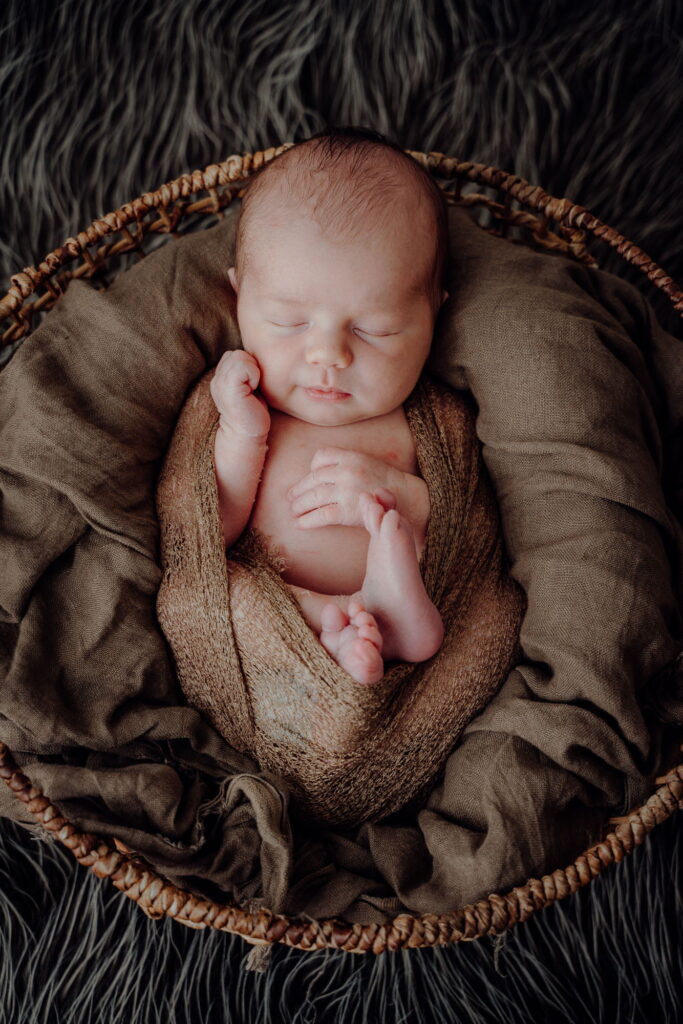
Could a shorter session work instead?
Sometimes, and we would rather say so than sell you hours you do not need.
If what you want is a handful of simple frames of the baby and one with each parent, a short sitting genuinely covers it. Our Mini Love Sitting is $295 and takes well under an hour, because it is one setup and no wardrobe changes. It is a real option, not a downgrade, and for a second or third baby it is often the sensible choice. There is more on where it fits in what a mini session is and whether it is worth it.
What a short sitting cannot do is give you the variety of a full morning, because variety in newborn work is bought with settling cycles, and settling cycles cost time.
What to do in the gaps
You will have time on your hands during a long session, and most parents are not sure how to use it. A few suggestions from the many mornings we have run.
During a settling stretch
Stay quiet and close. Babies pick up on a parent’s movement, so a calm adult in a chair helps more than hovering. If you need to talk, use a low voice. The white noise in the room is there to cover small sounds, not conversation.
During a feed
Take your time. A feed that is rushed leads to a baby who wakes within minutes, and that costs more time than it saves. If your baby feeds slowly, say so at the start and we will plan around it.
During a nappy change
Change them in the room if you can, because a trip to another part of the building wakes them. Bring more nappies than you think you need. A newborn can go through several in a morning.
When you are not needed
Sit on the couch, have a drink and rest. Many parents feel they should be supervising. We would rather you were relaxed, because a calm parent makes a calmer baby and better photographs.
A worked scenario: a ten-day-old and a three-year-old
Imagine a family driving in from Eastwood for a 9.30am start. The baby is ten days old, fed at 9, and the three-year-old has had breakfast but is already losing interest in the car.
The first half hour goes to the older child, because that is when they are at their best. They hold their brother with a parent’s hands underneath, and we take the sibling pictures before anyone is tired. Then we send them to the play corner with a snack and a favourite book, and the baby goes down for the quiet work.
The baby settles within twenty minutes, and we take the first wrapped set. When the baby stirs, the parent feeds them while the three-year-old comes back for a second round of short frames. After lunch, which the parents have brought with them, the baby sleeps again and we finish with the quiet frames of the parents and baby alone.
Nothing in that morning was rushed, and nothing ran badly. It simply took what it took, which was close to the three hours the booking said.
Signs the session is going well, and signs to take a break
Parents often ask how to tell whether things are on track. These are the cues we look for.
- Going well: the baby sleeps through small movements, feeds calmly, and wakes slowly rather than suddenly.
- Take a break: frequent startling, a persistent frown, rapid breathing or a baby who will not settle after a feed.
- Take a longer break: a fever, repeated vomiting or anything that worries you. Stop, and speak to your doctor or midwife.
Your baby’s comfort and health come before any photograph. If you are worried about anything, say so at once. We will pause, and we would always rather rebook than continue.
Packing for a long morning
- Food and water for the adults, enough for the whole morning.
- More nappies and wipes than you expect to use.
- Two or three feeds’ worth of milk or formula, if you use it.
- A dummy, if your baby takes one.
- A change of clothes for the baby, and a top for yourself.
- A snack and quiet activity for any older child.
- A phone charger, in case the morning goes long.
Pack the bag the evening before and leave it by the door. At ten days postpartum, the thing you will most want on the morning is one fewer decision. Put your own breakfast in the bag too, because the first thing most parents forget is themselves.
If you are a parent who finds waiting hard, give yourself one small job instead of watching. Write down the three people you most want the baby photographed with, or the three frames you would be sorry to miss. We will see that list when you hand it over, and it gives the quiet stretches a purpose that is yours rather than ours.
Common questions
Do we have to stay for the whole three hours?
You need to be there, yes — for feeding, and because we will not have a newborn in the studio without a parent present. But “there” can mean asleep on the couch. You are not required to stand and watch us work.
What if the baby screams the entire time?
Then we stop, you feed and comfort, and we wait. It happens, it is usually wind, and it usually resolves within twenty minutes. If a session genuinely will not settle, we finish what we can and bring you back another day rather than pushing an unhappy baby through a shot list.
Can we book an afternoon session instead?
We prefer mornings and we will usually push for one. Babies tend to be more settled early, and the late afternoon stretch that many newborns spend unhappy is exactly when an afternoon session would be finishing.
Is three hours standard across Sydney?
Roughly. Most full newborn sessions in Sydney are quoted between two and four hours, and studios quoting ninety minutes for a full posed session are either very optimistic or planning to stop early. Ask what happens if the baby needs longer — that answer tells you more than the number does.
How many photographs come out of three hours?
We shoot several hundred frames and deliver a curated set from them. The count is less useful than the range — you want the wrapped frames, the unwrapped ones, the hands and feet, and the parent shots, and that spread is what the morning is built to produce.
Let the baby run the clock
The only sessions that go badly are the ones being hurried. A newborn does not know you have somewhere to be, and every attempt to move faster than the baby wants costs more time than it saves.
So block the morning, bring lunch, and let it take what it takes. Three hours is not a long session. It is a realistic one.
If your morning genuinely cannot stretch that far, say so at info@tzportraits.com and we will talk about whether a short sitting fits your week better — that is a better conversation to have now than at the two-hour mark on the day.
Newborn portraits in our Epping studio
A warm, quiet studio, plenty of time and your baby's pace. Parents and siblings are welcome in the frame.